The Alexandra Lifeboat
New Zealand's First Professional Rescue Service | 1863-1885
They called it a death trap. The evidence calls it a pioneer. For 22 years, the Alexandra lifeboat served as New Zealand's first professional maritime rescue service, saving over 50 lives directly and 150+ through integrated operations with the Rocket Brigade.
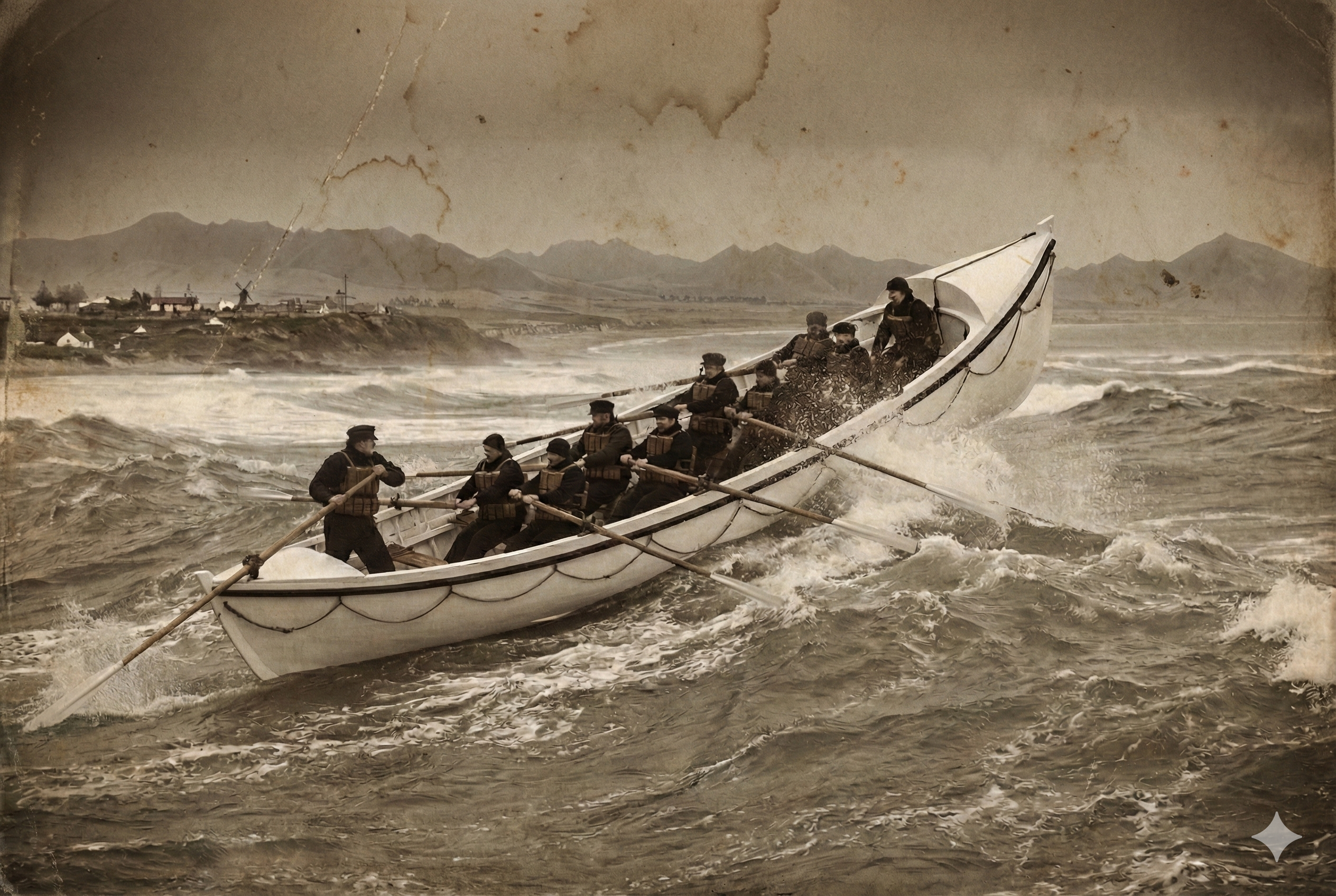
This AI generated image illustrates New Zealand's first professional rescue lifeboat in action. Built to Royal National Lifeboat Institution specifications in 1862, the 35-foot 6-inches Alexandra was a technological marvel of self-righting and self-bailing engineering. When she capsized four times during the Black Sunday disaster of May 14, 1882, the boat righted herself each time—exactly as designed—allowing 19 crew members to reboard safely and continue rescue operations that saved 24 lives. Far from being abandoned or a "death trap," the Alexandra served Timaru for 22 years (1863-1885), proving that professional maritime rescue could succeed even in New Zealand's most challenging coastal conditions.
The Pioneers (1863)
Christened July 10, 1863
On a crisp winter day in July 1863, Timaru gathered to witness history. The Alexandra—New Zealand's first professional RNLI-specification lifeboat—was christened and launched, marking the beginning of organized maritime rescue in the colony.
Cost
£300+
Massive investment for 1863Length
33 feet
Six-oared boatTechnology
RNLI-spec
Self-righting, self-bailingService Period
1863-1885
22 years activeOrdered from England by the Canterbury Provincial Government following the dangerous Geelong incidents of 1862, the Alexandra represented the cutting edge of 1860s maritime rescue technology. Her self-righting and self-bailing capabilities had been proven by the Royal National Lifeboat Institution in countless British rescues.
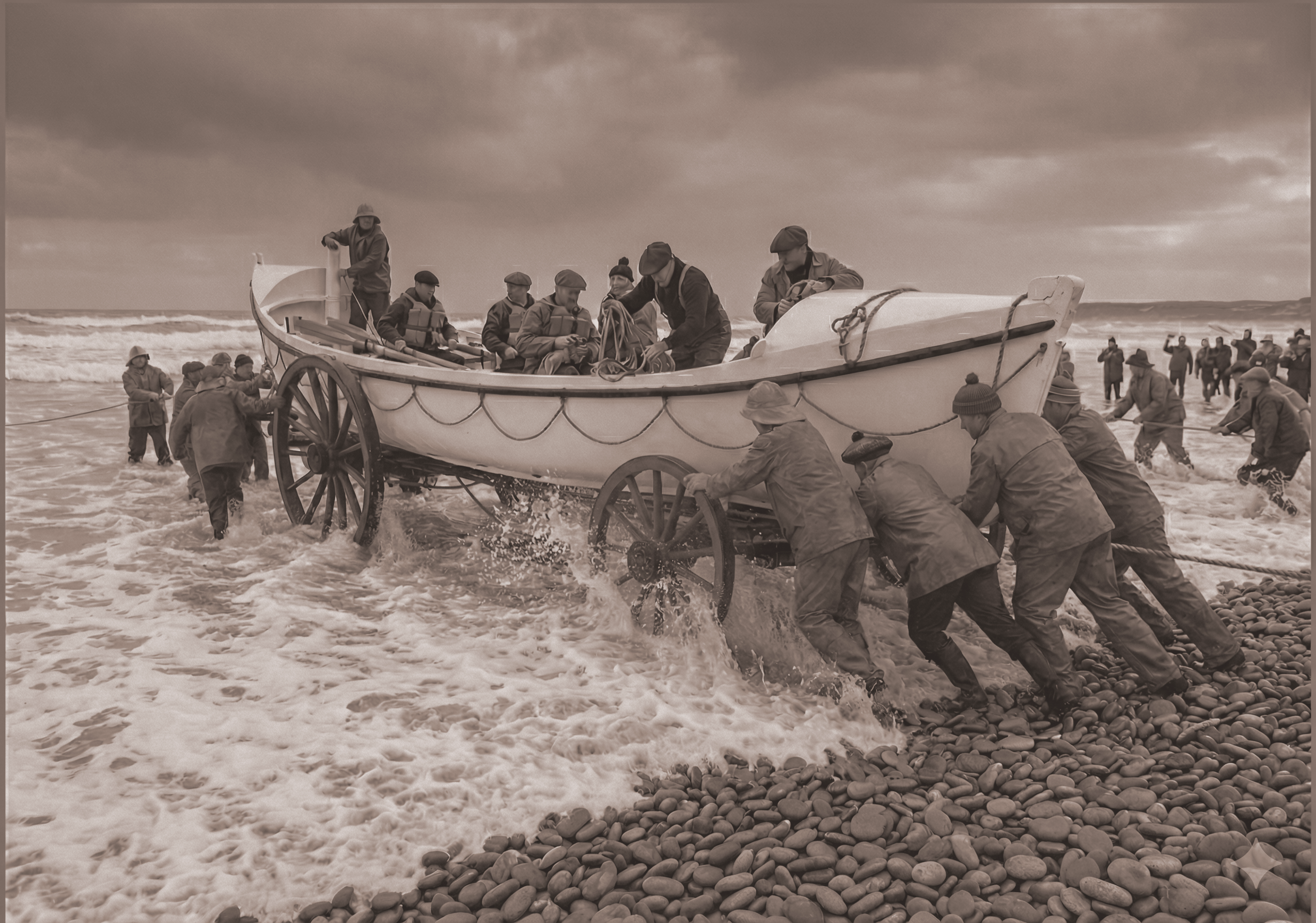
Caroline Bay, circa 1870s: Volunteers muscle the Alexandra and her carriage through the surf during a rescue deployment. This scene—requiring 40-50 townspeople to haul the 2-ton boat across rocky beach and through heavy surf—was repeated throughout the 1860s and 1870s. In 1879, when a vessel was reported in distress near Arowhenua River, townsfolk broke down the shed door with axes rather than wait for keys, demonstrating their commitment to the rescue service. Historical records document the Alexandra's active service from 1863-1885, including the Aurora (1870) and Black Sunday (1882).
The Rescues (1863-1885)
38 Documented Activities
Historical research has identified 38 documented lifeboat activities throughout the Alexandra's service period, conclusively disproving the myth of a 13-year gap between 1869-1882.
Notable Rescues
Prince Consort - December 20, 1866
The Alexandra's first documented successful rescue. Hauled to a distant launch site by 40-50 townspeople, the lifeboat crew rescued two seamen while Customs officer P.C. Bertram swam out to save a third. Saved 2 lives—the first verified test. This early success validated the investment in professional rescue equipment.
SS Maori - December 18, 1869
During passenger transfer in rough conditions, the steamer's own lifeboat capsized, throwing all into the sea. Harbour Master Mills launched the Alexandra with volunteer crew and saved 1 life—survivor Ferrier was rescued from the water. Two passengers drowned (J.M. Balfour and A.B. Smallwood), but the Alexandra's rapid response prevented further loss of life.
Aurora - June 20-21, 1870
Harbourmaster Captain Mills launched the Alexandra in deteriorating winter weather with heavy swell and successfully rescued all 4 crew members. This incident, occurring during the alleged "gap years," demonstrates the lifeboat's active service throughout the 1870s and disproves the abandonment myth.
Princess Alice - July 18-20, 1872
The Alexandra launched during a heavy south-easterly storm. While attempting rescue, the lifeboat capsized on a reef but immediately righted itself—proving the technology worked exactly as designed. The crew scrambled back aboard unharmed, demonstrating the boat's life-saving engineering.
The Technology
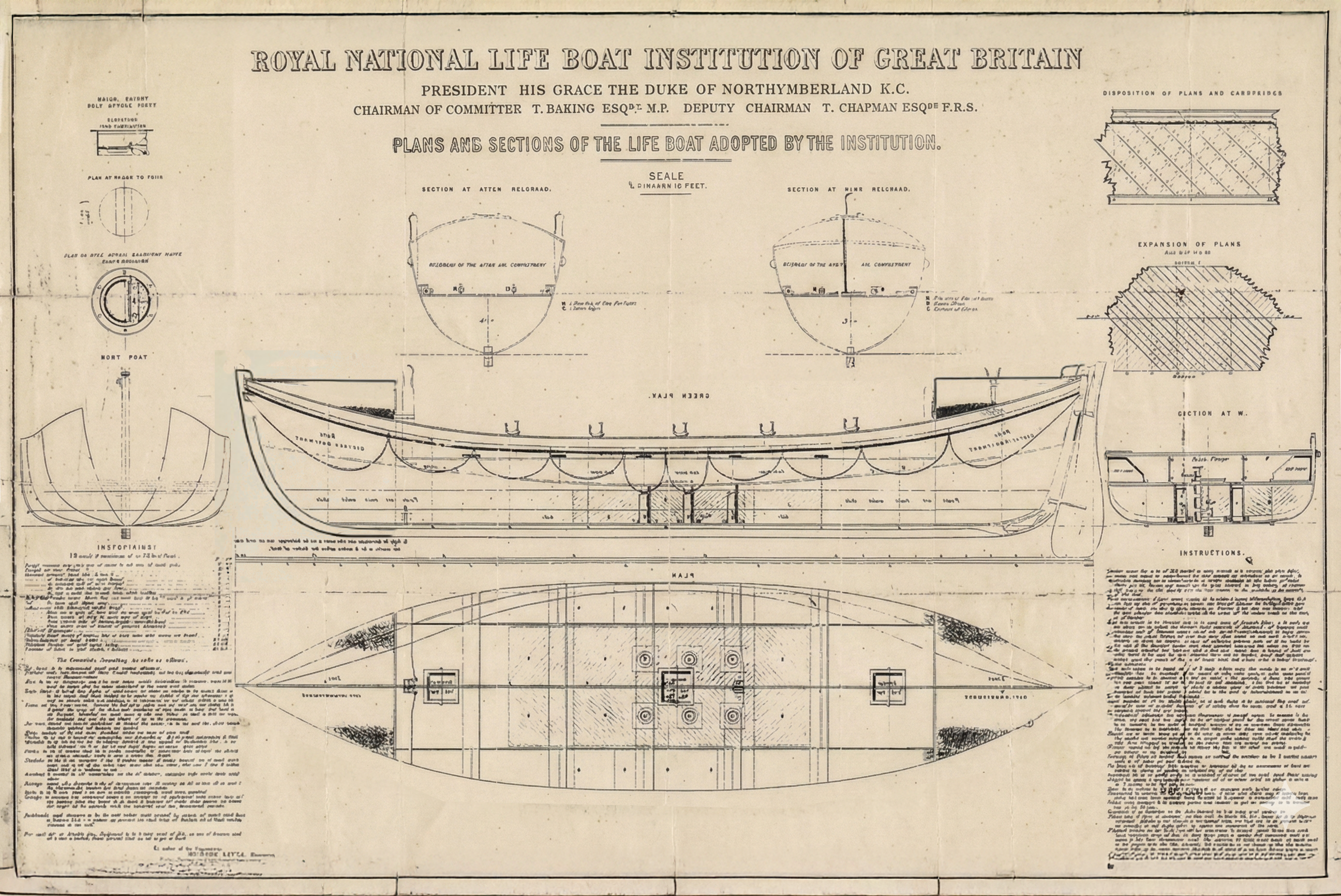
AI recreation of the typical RNLI plans directly refute claims that the Alexandra was poorly designed or dangerous. The cross-sections reveal sophisticated engineering: the weighted keel provided stability, enclosed air chambers ensured buoyancy even when swamped, and the self-righting mechanism (visible in the hull curvature and ballast placement) required no human intervention. When critics point to the boat's capsizes as evidence of failure, they fundamentally misunderstand this design. The Alexandra was designed to capsize and self-right in conditions that would sink conventional boats.
Engineering Marvel of the 1860s
⚙️ Self-Righting
Specially designed hull with internal water tanks that automatically righted the boat when capsized. No crew action needed—pure engineering.
💧 Self-Bailing
Deck valves that allowed water to drain automatically, keeping the boat afloat even when swamped. Stayed operational in any conditions.
🪨 Portable Design
Weighed under 2 tons, allowing volunteers to haul her overland to launch sites when shore conditions were poor. Community-powered rescue.
Designed by the Royal National Lifeboat Institution—world leaders in maritime rescue—the Alexandra represented the pinnacle of contemporary lifesaving technology. She could be launched in conditions that kept other vessels in port.
Black Sunday: Her Finest Hour
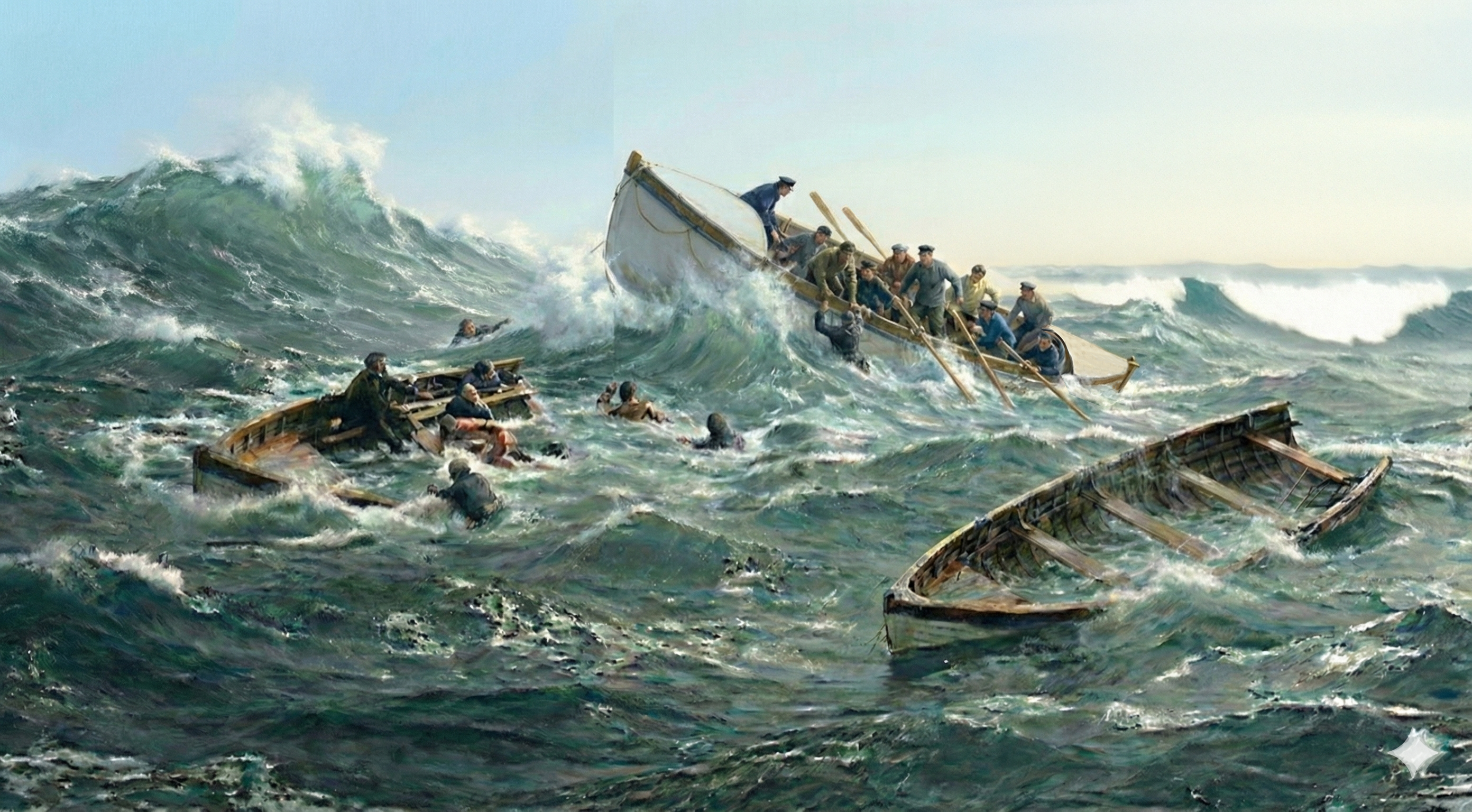
Dan Bradley stood at the tiller of the Alexandra as mountainous seas like these engulfed Caroline Bay. His brothers Philip and Isaac were among those to be rescued after their boat capsized, Dan's lifeboat crew pulled them from the water. When the Alexandra herself capsized—once, twice, three times—she righted herself each time, dumping her crew into the sea but remaining afloat. Nineteen men, including the Bradley brothers. Brothers-in-law George Sunaway and Carl Vogeler, were to crew successive missions, rowing back into the chaos. They saved 24 lives. Captain Mills, who commanded the Rocket Brigade and trained these volunteers, died from exhaustion after being rescued from the water. All five Bradley family members survived and were among the 43 who received Benvenue medals for their service. The Alexandra performed exactly as designed— proving that British engineering and Timaru courage could succeed even when nine lives were lost to the sea.
May 14, 1882 - The Ultimate Test
On Timaru's darkest maritime day, the Alexandra faced her ultimate test. Multiple vessels broke free in mountainous seas. Nine people died that day—including Harbourmaster Captain Alexander Mills, who led both the lifeboat and Rocket Brigade.
The Truth About the Capsizes
The Alexandra capsized four times in catastrophic conditions. Each time, she self-righted exactly as designed. This wasn't failure—this was 1860s RNLI engineering working perfectly under the worst possible test. Volunteers saved 24 lives in mountainous seas, and enabled an additional 19 crew to reboard safely after capsize—a total of 43 souls escaped peril.
The famous "43" associated with Black Sunday doesn't refer to lives saved—it's the number of commemorative medals awarded by the Timaru Freemasons to all rescuers who participated in that day's heroic efforts.
The Legacy
50+
Lives Saved Directly
150+
Through Integrated System
38
Documented Activities
1 of 3
Surviving Worldwide
What the Alexandra Proved
- Professional maritime rescue worked in colonial New Zealand
- Coordinated sea-and-shore response saved lives
- Investment in safety equipment paid dividends in human lives
- Good design, brave crews, and professional training save lives
- Self-righting technology validated under extreme conditions
Damage to the lifeboat and repairs
"The repairing of the damage to the lifeboat, received on the 14th ult., is now about completed, and the “Alexandra” is as good as ever. The following description of her, as an object that has been much read and talked of lately, may be interesting to our readers, many of whom have never seen her:
The “Alexandra” is 36ft long over all, 6ft 3in beam, 2ft 9in total interior depth in centre, with a sheer of 2ft 3in—that is, her bow and stern rise to 3ft above the keel level. She is built without the ribs or framework commonly seen in boats, the sides being composed of two thicknesses of half-inch spruce boards, crossed diagonally, with pitched canvas between them, all well fastened together. The body of the boat is stiffened by transverse pieces of timber, technically called “floors,” placed every eighteen inches, and by a deck twelve inches above the bottom. Around the top runs a gunwale of hard wood, 2½in by 2in, and a “belting,” 2in by 2½in. The keel consists of a lower section of solid iron, 3in wide by 2½in deep, and an upper section of wood 3½in by 2in, the total depth being 4½in. The whole is bolted to a strong kelson inside.
The constructions which make the “Alexandra” a “lifeboat” have reference to buoyancy and self-righting power. The latter is given by the weight of her iron keel, and large “drum-head” air chambers, which take up six feet of length at each end of the boat, and are of considerable capacity, the greater part of which is above the gunwale level at the centre of the boat. Possibly the boat might remain upside down in perfectly smooth water; but it is impossible for her to do so if any motion is imparted to her, as of course must be the case in a sea. Her buoyancy is secured by the drum-head ends mentioned, by a space twelve inches deep next the bottom being covered with a water-tight deck, forming a large air chamber, and by a row of air chests along each side of the boat under the side-seats. Should she fill with water above the deck, half a dozen valves, each six inches in diameter, let the water escape, and it can rarely, if ever, happen that the boat would be so loaded down as to place this deck below the level of the water without so that the water within would not make its way out. The deck is well caulked, and there is a small pump for use in case any water should find its way into the little hold. The air-chests under the seats are removable. They are made of three-eighth inch boards, pitched, covered with calico, and painted. The drumhead air-vessels are also made air-tight with pitch, canvas and paint.
The boat has seven thwarts, and also seats all along the sides. She is supposed to be pulled with seven oars, and is steered in fine weather by a rudder and in rough by two steer-oars, 25ft long, with 9ft blades. Along the outer sides are lines, fastened in short loops to the belting, for persons in the water to catch hold of, and each oarsman has beside him a “life-line” eight or ten feet long with a piece of cork at the end to throw to anyone within reach. Besides these a man stationed in the bow has a longer line, to throw to anyone more distant from the boat. Other equipments, launching carriage, cork jackets, anchor, &c., it is unnecessary to describe.
From the nature of the damage sustained by the boat on the 14th May, it is believed that it was done in one of the trips to the surf-boat, on the occasion when Falgar was taken off the buoy. While this was being done the lifeboat turned broadside to the sea, and a big wave drove her down on the surf boat, at the same time canting her so that she struck the bow of the lighter evenly with both gunwales. It is probable that Macdonald was killed by this collision. The force of the blow must have been very great. The gunwale (2½in by 1½in) and belting (2½in by 2in), and about a foot of side timbers on both sides of the boat were cut through, the side seats and air-boxes below also being smashed. From the construction of the boat’s sides, the replacing of the damaged planking required a great deal of tedious work. The repairs have been well and faithfully executed by Mr W. Murley, and the “Alexandra” is “as staunch and strong, and as fit for her special vocation as ever.”
Timaru Herald 13 June 1882 Page 2
Return to Caroline Bay - 2025
After decades away, the Alexandra returns home. Thanks to the Timaru Host Lions Club's fundraising efforts, she'll receive a purpose-built shelter at Caroline Bay—telling her real story at last.
Not a death trap. A pioneer.