The Lifeboat: Its History and Heroes
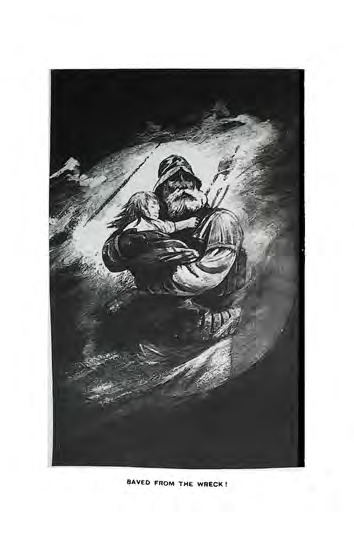
About This Book
Published around 1900, F.M. Holmes' The Lifeboat: Its History and Heroes stands as one of the earliest comprehensive popular accounts of lifeboat development in Britain. Written at the turn of the 20th century—just as the Victorian era was ending—this book captures the spirit of an age when maritime rescue was still a matter of recent innovation and heroic sacrifice was vividly remembered.
Holmes wrote this as part of a series celebrating engineering triumphs, with the explicit goal of presenting "in a popular and non-technical manner, the story of the invention and development of the Lifeboat and of the Lifeboat Service, illustrated by a number of characteristic incidents of Lifeboat rescue."
Historical Context: Britain's Life-Saving Revolution
Holmes wrote from firsthand research, interviewing officials at the RNLI headquarters, visiting the Institution's stores, and examining lifeboats under construction. He drew on historical sources including the Tyne Mercury, The Gentleman's Magazine (1806, 1834), parliamentary reports from 1804, and papers by Sir David Brewster, among others.
The Three Tyneside Milestones
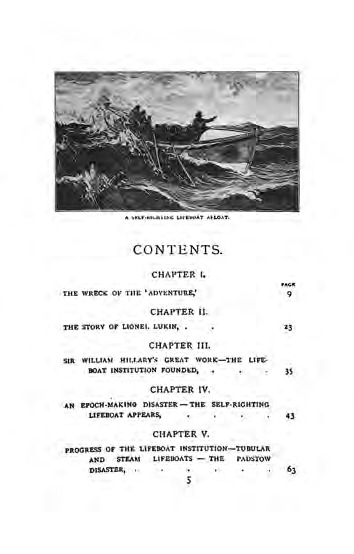
Holmes identified three critical wrecks at the River Tyne that drove forward Britain's life-saving capabilities:
- 1789 – The Adventure: This disaster gave birth to the lifeboat concept itself. The ship stranded barely 300 yards from shore in a September storm, and thousands watched helplessly as the crew perished one by one in the rigging because "no boat can live in that sea."
- 1849 – Unnamed disaster: Led directly to the development of the self-righting lifeboat design, a revolutionary safety feature that would prove crucial in surviving capsizes.
- 1864 – The Stanley: This steamship wreck prompted the formation of the first Volunteer Life Brigade at Tynemouth, driven by Alderman John Foster Spence, because "numbers were lost by that wreck, close to the shore, chiefly for want of organization among the spectators, and also because they did not know how to work the rocket apparatus."
Coverage and Structure
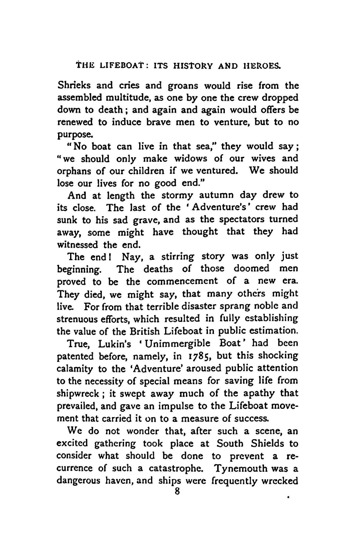
- The Wreck of the 'Adventure' (1789)
- The Story of Lionel Lukin (early lifeboat pioneer)
- Sir William Hillary's Great Work – The Lifeboat Institution Founded
- An Epoch-Making Disaster – The Self-Righting Lifeboat Appears
- Progress of the Lifeboat Institution – Tubular and Steam Lifeboats – The Padstow Disaster
- A Lifeboat Trip Round the Coast – Various Types of Lifeboat – What is the Ideal?
- The Institution's Storeyard
- Building a Lifeboat
- The Lifeboat in Action – Some Stories of Lifeboat Work
- Organisation of the Institution – Lifeboat Saturday
- The Rocket Apparatus – Life-Saving Brigades
Eight Types of Lifeboats (c.1900)
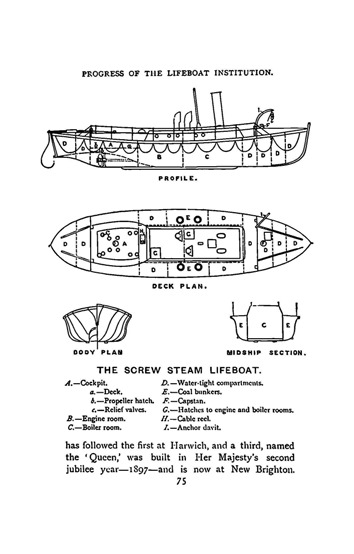
Holmes describes in detail the eight different lifeboat types under RNLI control at the turn of the century, explaining how each was engineered to meet "various peculiarities of coasts and of the weather." This technical diversity—ranging from self-righting boats to steam-powered rescue vessels—demonstrated the sophistication of late Victorian maritime engineering.
Relevance to the Alexandra Story
Why This Book Matters for Timaru's Maritime Heritage
While Holmes' narrative focuses primarily on British coastal stations and RNLI operations, his account provides the essential technical and organizational context for understanding the Alexandra lifeboat in Timaru, New Zealand.
The Alexandra, which arrived in New Zealand in 1863, was built to RNLI specifications during the very period Holmes documents. His descriptions of self-righting technology, lifeboat construction methods, crew organization, and integrated rescue systems (lifeboats working alongside rocket brigades) directly illuminate the Alexandra's design philosophy and operational context.
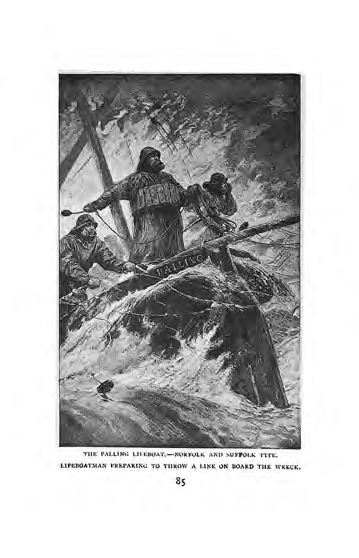
Key Connections:
- Self-Righting Design: Holmes explains the evolution of self-righting technology through the 1850s–1860s. The Alexandra's four successful self-rightings during Black Sunday (1882) vindicated exactly the design principles Holmes describes.
- Integrated Rescue Systems: Holmes documents how British stations combined lifeboats with rocket apparatus. Timaru followed this model precisely, with the Alexandra working alongside the Boxer rocket brigade from 1867.
- Organizational Models: The RNLI's volunteer structure, training methods, and reward systems that Holmes outlines mirror how Timaru organized its lifeboat service and Rocket Brigade under Captain Alexander Mills.
- Technical Innovation: Holmes' chapter on lifeboat construction helps explain the materials, buoyancy systems, and structural features that made the Alexandra one of only three surviving self-righting lifeboats worldwide.
- Contemporary Perspective: Most importantly, Holmes captures what people at the time (1900) understood about lifeboat history—providing insight into how the Alexandra and similar boats would have been viewed by their contemporaries before myths and misconceptions accumulated over the 20th century.
The Victorian Voice
"The change that has taken place in life-saving service on our coasts during the last hundred years or so is truly wonderful."
Holmes writes with Victorian earnestness about technological progress as moral triumph. His tone combines technical description with narrative drama—rescue accounts are "characteristic incidents" demonstrating not just engineering success but national character. Terms like "gallantry," "noble," and "splendid bravery" pervade his prose.
This makes the book valuable not just as a technical reference but as a window into how late Victorian society understood heroism, innovation, and public service. The same values that drove RNLI volunteers in Britain animated the crews of the Alexandra and Rocket Brigade in colonial Timaru—a shared culture of maritime rescue that transcended geography.
Research Value
For researchers investigating the Alexandra and Timaru's maritime heritage, Holmes provides:
- Technical baseline: Specifications and operational procedures for RNLI-pattern lifeboats of the 1860s–1900 period
- Comparative context: How Timaru's system compared to British coastal stations
- Contemporary sources: Holmes cites original documents (parliamentary reports, RNLI records, newspapers) that help verify or contextualize New Zealand records
- Terminology and concepts: Proper Victorian-era terms for equipment, procedures, and organizational structures
- Myth correction: By understanding what was actually known and practiced in lifeboat operations circa 1860–1900, we can better evaluate later claims and narratives about the Alexandra
The book is particularly valuable for countering the "death trap" myth that accumulated around the Alexandra. Holmes' account makes clear that RNLI self-righting lifeboats were considered state-of-the-art technology, praised for their safety features, not dismissed as dangerous failures.
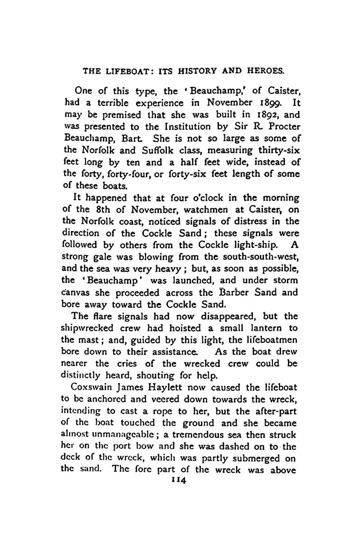
Access the Digital Edition
The complete 164-page book is now available as a searchable PDF, digitized from an original copy and processed with optical character recognition (OCR) for research accessibility.
Download: The Lifeboat - Its History and Heroes (PDF, 13MB)Digitization completed January 2026 by wuhootimaru.co.nz
Closing Thoughts
Holmes concludes his narrative where it began—at the River Tyne—reflecting on how "methods of life-saving work on the coast might almost be said to be epitomised there." He marvels at the century-long transformation from complete helplessness to sophisticated, coordinated rescue capabilities.
"And while these qualities of our race endure, we may believe that a constant succession of the younger men will arise to take the place of the veterans, and that the life-saving service of the coast will go on prospering and to prosper, and continue to win fresh victims over the raging sea."
This Victorian optimism proved well-founded. The Alexandra served Timaru for 22 years (1863–1885), the integrated rescue system saved over 150 lives, and the harbour construction that eventually rendered the lifeboat unnecessary was itself a triumph of engineering that solved the problem permanently.
Holmes would have recognized Timaru's story as a perfect exemplar of the "marvellous ingenuity to plan the appliances and to organize the services" combined with "determined perseverance and splendid bravery" that he celebrated throughout his book.