Lifeboat Operations in Action
Introduction: "In All Weathers, At All Times"
"In all weathers, and at all times, a lifeboat is liable to be called out to her work. The wind may be blowing great guns, the snow and rain may be lashing the face like whipcord, the heavy sea fog may be brooding like a visible miasma over the deep; but away must go the boat to the saving of life."
Holmes' Chapter 9, "The Lifeboat in Action," provides detailed accounts of actual rescue operations from British stations in the 1880s-1900s. These stories aren't just dramatic narratives—they're technical manuals showing exactly how Victorian lifeboat crews worked, what challenges they faced, and how they overcame them.
Understanding these operations is essential for understanding what Captain Mills and the Alexandra crews in Timaru were doing. The procedures, techniques, and challenges were identical—same boats, same conditions, same life-or-death decisions.

Step 1: Detection & Alarm
How Crews Knew They Were Needed
Distress Signals from Vessels:
- 'Flares': "A vessel finds herself damaged and helpless in a howling storm, or drifting to destruction on a reef or bank of sand, and she forthwith burns a light"
- Blue Lights: "Vivid and brilliant"
- Improvised Flares: "A blanket steeped in naphtha or tar"
- Rockets: For visibility in darkness
- Signal Guns: "Boom out signals of distress at intervals"
- Flag Signals: "A 'want assistance' signal is usually a ball hoisted over a square, and a rough and ready method of making this signal is by hauling up a bucket over a hatchway cover, or even to turn the British flag upside down"
- Improvised: "Sometimes a vessel is reduced to an old sheet for a signal"


Watch System
- Lightships: "So often moored near dangerous sands"—constant watch
- Coastguard: "Ever on duty"
- Local seafaring men: "With eyes keen as hawks for anything unusual on the broad strip of sea within their far-reaching sight"
- Reward System: "Seven shillings is given by the Lifeboat Institution to the man who brings the first intelligence of a wreck, so placed as to be out of sight of a coastguard on duty"
Sounding the Alarm
"His alarm soon spreads, and the booming of a small cannon at night, or the hoisting of a flag by day, or maybe the ringing of a bell, soon calls the lifeboat crew together."
Response: "The men run in hurriedly from all parts of the little village, and those who secure a place in the boat quickly don their cork life-belts, and the boat is taken off her carriage."
Step 2: Launch Preparation
Pre-Launch Sequence
- Crew Assembly: "The coxswain knows his work and knows his men"
- Equipment Check: Boat already equipped with full 220-item inventory from storeyard
- Carriage Loading: Boat mounted on wheeled carriage if not already positioned
- Horse Harnessing: "The horses are harnessed, and away they go"
- Route Selection: "They are bound for the best spot for launching near to the wreck"—coxswain's judgment critical
- Positioning: Cart backed down to water's edge
- Crew Boarding: "The lifeboatmen are seated each in his place with his oar ready"
- Coxswain Ready: "The coxswain holds the steering lines in his hand and waits his chance"
Critical Equipment at Launch:
"At a lifeboat launch, you see the value of many of the stores supplied from headquarters; you see the great use of the transporting carriage, which, with boat on board, is being whirled along the beach by hurrying horses; you see the value of the skids and the grease for smoothing and oiling the ways; you see the use of the numerous lanterns and ropes and launching tackle."
Step 3: The Launch - Most Dangerous Moment
Timing Is Everything
Holmes describes the critical launch moment:
"The water boils and foams and dashes around so that it would seem impossible the boat could ever force her way through the breakers, foaming and tumbling on the beach. Now! The practised eye of the coxswain sees the right moment and he gives the word."
Launch Technique:
- Wait for Gap: Coxswain watches wave patterns, waits for momentary lull
- Command: "Whiiz, the launching ropes are pulled by the assistants"
- Rush Down: "The boat rushes down to the tumultuous water"
- Immediate Rowing: "The crew dip their oars and struggle and strain at them for dear life"
- Fight Through Surf: "The buoyant boat rises like a bird, and while the broken, green and foamy waters dash on board, she cuts through them, shakes herself free from them, mounts the crest of the next great billow"
- Gain Speed: "Gathering speed from the disciplined and well-directed efforts of her stalwart crew, makes her way onward to that piteous signal yonder amid the tempestuous seas"


Step 4: Fighting to the Wreck
How Self-Righting Boats Handle Extreme Seas:
"No matter what water break on board, it runs away through the self-emptying relief valves; no matter what huge wave rise in front, the large bow air-case rises to meet it, or cuts through the top of it. Tossed hither and thither in a smother and a swelter of tumbling, thumping, dashing billows that seem to treat her like the veriest little cork, yet she lives, and she thrives, for she rises buoyant to the waves, and she fights her way nobly onward."

Navigation in Storm Conditions:
- Maintain Flare Visibility: "Well is it that the flare is still burning"
- Use Pre-Launch Bearings: "Well is it that the coxswain has clearly taken the bearings of the wreck before he started"
- Problem: "Otherwise, how could he distinguish her in this storm of spray and rain, and amid these mountainous seas; so high they foam and dash, they seem to touch the sky"
- Listen for Crew: "Amid the scream of the gale can be heard the shout of the storm-tossed men she has come to save"
- Watch for Wreck: "Amongst the foam and the spray can be seen the black masses of the broken ship"
Real Example: Grace Darling at Holy Island (March 6, 1883)
Vessel: Ketch 'Mary Tweedlie' of Berwick
Conditions: "Stormy northerly gale... the whole bar and the sea being a mass of broken water"
Challenge: "The difficulty of reaching the vessel was so great that the crew were wrestling with the sea for more than three hours before they reached the ship."
Repeated Setbacks: "The men, indeed, became almost exhausted, and on every occasion that they seemed sufficiently near to cast a line on board, a tremendous wave hurled the boat back again like a toy a hundred yards, or so, astern. Repeatedly the determined men laboured near, and repeatedly they were dashed back."
Result: "At last the boatmen were able to get a rope fast to the ship and took off two men in a very exhausted and benumbed condition by a lifebuoy."
Step 5: The Rescue - Most Perilous Work
"Sometimes the Most Perilous of All"
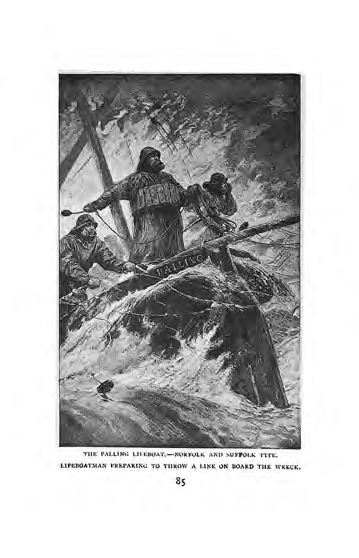
"The actual rescue from a wreck is sometimes the most perilous of all a lifeboat's work. Sometimes heavy seas repeatedly wash the boat away from the wreck, in spite of all efforts."
Approach Techniques:
The Dilemma: "The lifeboat has to draw sufficiently near the wreck to take off the men, and yet she must keep a sufficient distance away, to prevent a collision."
Coordinated Rowing: "So, on such occasions, while part of the crew back the boat toward the wreck, others are ready to pull literally for dear life to take the boat out again."
Debris Hazard: "The space between the boat and the wreck is full of broken pieces of the ship, and huge yeasty waves dash hither and thither, while currents and eddies swirling round fore and aft of the wreck would catch the boat at any moment, if she should become unmanageable, and crush her against the wreck or the sand."
Rescue Methods (Multiple Options):
- Line Throwing: "A line is thrown on board, sometimes by a grapnel and sometimes by a heaving cane"
- Direct Jump: "Some of the wrecked men try to jump into the boat"
- Water Recovery: "Others may fall in the water, and are plucked out by the lifeboatmen"
- Lifeline Grab: "Or they clutch the lifelines hanging in festoons round the boat"
- Jib-Boom Transfer: "Sometimes they are taken off by the jib-boom"
- Anchoring & Veering: "Or the coxswain may see fit to anchor the boat a short distance from the wreck, and then veer down to it"
- Boarding Party: "Sometimes the lifeboatmen have to board the vessel to take off exhausted members of the crew"
"Methods are various, but with the crew rescued, the lifeboat joyfully turns her head to shore"

Real Example: Andrew Pickard at Wexford (January 16, 1892)
Vessel: Ketch 'Marys' of Aberystwith
Conditions: "Whole gale of wind from the south-east... a very heavy sea, which at times broke over the boat, and filled her to the thwarts"
Stranded Position: "The vessel had now become stranded, and repeatedly as the boat endeavoured to approach her, she was dashed away by the heavy seas, which broke over the ketch, and filled the boat."
Persistence: "Again and again she approached, but was driven away."
Result: "At length determined perseverance and skill triumphed, and after a hard struggle, the crew of three men, who were nearly exhausted, were rescued."
Major Rescue: SS Eider (January 31-February 2, 1892)
The Largest Coordinated Lifeboat Operation of the Era
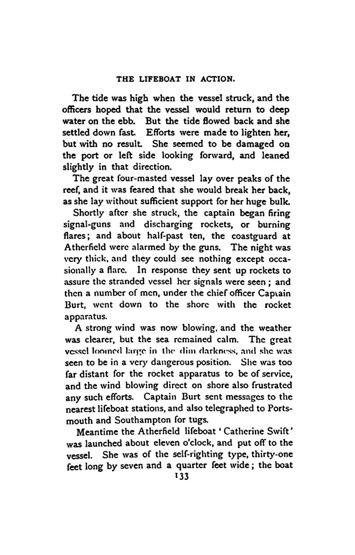
Vessel: North German Lloyd steam-ship 'Eider' (four-masted, 400+ persons aboard)
Location: Atherfield Ledge, Isle of Wight
Cause: "In a thick fog and a heavy sea, she crashed with a grinding noise on to the reef of rocks"—navigation error in fog
Timeline of 48-Hour Rescue:
Sunday Night (10:00 PM): Vessel strikes reef; signals of distress; coastguard alerted
11:00 PM: Atherfield lifeboat 'Catherine Swift' launched—self-righting type, 31 feet × 7¼ feet
Early Morning: Captain initially hopeful of towing off, declines evacuation
Monday Morning (8:00 AM): Gale increases; Brightstone Grange lifeboat arrives—self-righting, slightly larger; takes off first dozen passengers "though with considerable difficulty... many feared to enter the first lifeboat as a very heavy sea was running"
10:00 AM: Storm raging; Brooke lifeboat joins (third self-righting boat); several tugs appear but cannot approach close enough
2:00 PM: "Situation had become very serious, for heavy seas struck the great ship and even broke over her"
3:00 PM: Weather moderates slightly; three lifeboats begin coordinated evacuation
First Lifeboat Experience: "The first lifeboat had a very rough passage, the sea breaking over her repeatedly and drenching everybody to the skin. Four children covered with sacking were placed at the bottom of the boat. The landing was very difficult, and was only accomplished by the aid of fishermen and coastguardsmen."
Public Response: "Loud cheers were raised as time after time the lifeboats landed with their human freight and steadily returned again to the stranded vessel, the rescued persons joining in the shouts."
Nightfall: All passengers evacuated; 166 crew remain aboard with captain
SS Eider: Day Two (Monday Night - Tuesday Morning)
Monday Night: "Wretched experience for the crew... vessel sprung a leak and the stern became filled with water, and all efforts to lower it by pumping were fruitless"
Tuesday 7:00 AM: Captain signals for assistance again; "alarm guns boomed"
Catherine Swift Returns: "Away went the 'Catherine Swift' again in a most dangerous sea, and brought off several of the officers and men. So wild became the sea, however, that the risk of remaining on board was even less than the risk of the perilous passage in the boat."
Storm Intensifies: "The storm now blew in fury. Squalls of rain and hail burst over the scene and the wind was terrific."
Final Launch: "With the aid of numbers of willing helpers, the Atherfield boat was again launched through the surge, though it occupied about three quarters of an hour to fairly get her afloat."
Worst Conditions Yet: "The breakers were terrific, tossing the fine boat about like a cork. 'Time after time,' says a writer in the 'Times' who seems to have been an eye-witness, 'she was carried back by the waves. In one instance her bow was lifted high up in the air for a moment, and she seemed to stand erect on her stern. Then, with an alarming sweep, the fore part of the boat flew over and crashed into the water, head landward and close to the beach. The spectators stood almost breathless during the struggles of the crew in the breakers, and sent up a ringing cheer when the boat's head again put to sea.'"
Coxswain's Judgment: "At length the men reached the comparatively smooth water on the lee of the 'Eider' and were soon alongside her. The coxswain would not take any of the crew on board for nearly half-an-hour, as he considered they would be running greater risk in the lifeboat than on the vessel, while the sea ran so high."
Result: All 379+ persons saved (passengers + crew)
Final Scene: "The scenes on shore were most touching as each boat-load reached the beach, the rescued men embracing one another in joy for their escape. Men and boys of the lowest rank in the service went first, the officers following in order of rank, and Captain Heincke the last of all and most reluctantly."
Connection to Timaru & Black Sunday
The SS Eider rescue demonstrates exactly what the Alexandra was designed to do—and what self-righting boats routinely accomplished:
- Same boat type: Atherfield's Catherine Swift (31 ft, self-righting) nearly identical to Alexandra (32-34 ft, self-righting)
- Extreme conditions normal: "Bow lifted high... seemed to stand erect on stern... flew over and crashed"—this is routine operation, not catastrophe
- Multiple trips standard: 41 trips over 48 hours shows persistence expected of lifeboat crews
- Coxswain judgment critical: Waiting half-hour before taking crew shows same decision-making Captain Mills faced
- Self-righting essential: Boats repeatedly battered but kept working—exactly what happened to Alexandra on Black Sunday
Capsizing: Routine Operational Risk
Mark Lane at Gorleston (September 30, 1899)
Boat: Large Norfolk & Suffolk type, 46 feet × 12 feet 9 inches
Conditions: "Heavy gale... from the south-east, and the sea also was very rough, while rain was falling, and the weather was thick"
What Happened:
"The lifeboatmen stated, the sea on the bar and for half a mile out was the heaviest they had ever experienced. In returning, with the drogue out, the sails furled down to a goose-wing, and the forward ballast tanks empty, one terrible sea pooped the boat; every man on board was under water, and it was estimated that the boat—the behaviour of which the men warmly praised—was carried by that sea a distance of at least two hundred yards."
"But she bravely arrived home safely with her gallant crew and the rescued men"
Why Self-Righting Design Mattered:
- Capsizing expected: Design assumed boats would flip; built to handle it
- Automatic return: Physics brought boat upright without crew action
- Self-bailing: Water drained through relief valves automatically
- Resume operations: Crew could continue rowing immediately after righting
- Multiple capsizes survivable: Boat could capsize repeatedly and keep working
The Alexandra's four capsizes on Black Sunday were EXACTLY what the design was meant to survive—and it did, perfectly.

Step 6: Return to Shore
Homeward Journey:
- Turn for Shore: "With the crew rescued, the lifeboat joyfully turns her head to shore"
- Anxious Crowd: "Where an anxious crowd is eagerly awaiting her"
- Cheering: "Again and again cheers break forth as she is seen nearing the beach"
- Landing Assistance: "There are plenty of willing hands to help when she reaches home again"
- Rescued Care: "The shipwrecked men are generally tended at the Sailors' Home, or by agents of the Shipwrecked Mariners' Society"
Lessons for Understanding the Alexandra
What These Operations Teach Us About Black Sunday
1. Four Capsizes Was Normal Operations:
The Mark Lane was completely submerged, carried 200 yards, yet "the men warmly praised" the boat's behavior. The Grace Darling was "dashed back like a toy" a dozen times. The Alexandra's four capsizes on Black Sunday fit standard operational patterns.
2. Self-Righting Worked Exactly as Designed:
Every account shows boats righting themselves, crews bailing out, operations continuing. The Alexandra's four successful self-rightings vindicated the technology, not condemned it.
3. Persistence Was Expected:
Three hours of wrestling seas (Grace Darling), three attempts then returning to try different boat (Holyhead/Rhosneigir), 41 trips over 48 hours (Eider)—lifeboat work meant repeated efforts under extreme conditions.
4. Coxswain Judgment Critical:
Captain Mills made the same life-or-death decisions documented in these accounts: when to launch, when to approach, when conditions were too dangerous, when to persist, when to wait.
5. "Death Trap" Myth Is Nonsense:
These same self-righting boats—same design, same size, same technology as Alexandra—saved thousands of lives. The SS Eider alone: 379 people rescued by three boats nearly identical to Alexandra. These were not death traps—they were the most sophisticated maritime rescue technology available.
Conclusion: Professional Operations, Not Desperate Gambles
"What a striking contrast the whole story affords to the terrible loss of the ship 'Adventure' in 1789, when the crew were lost off the mouth of the Tyne in face of crowds of spectators; and how remarkably it illustrates the development of the Lifeboat and of Lifeboat work in the hundred or so years intervening between the two scenes."
Holmes' rescue accounts reveal sophisticated operations with standardized procedures, proven techniques, and professional decision-making. These weren't desperate gambles by brave amateurs—they were trained volunteers executing proven protocols with state-of-the-art equipment.
The Alexandra crews in Timaru operated the same way: trained in RNLI procedures, equipped with RNLI-spec boats, following operational patterns proven at hundreds of British stations. When we read accounts of Alexandra rescues—including the four capsizes on Black Sunday—we should see professional operations matching British standards, not colonial improvisation or equipment failure.
operating exactly as Victorian engineers designed it to work.