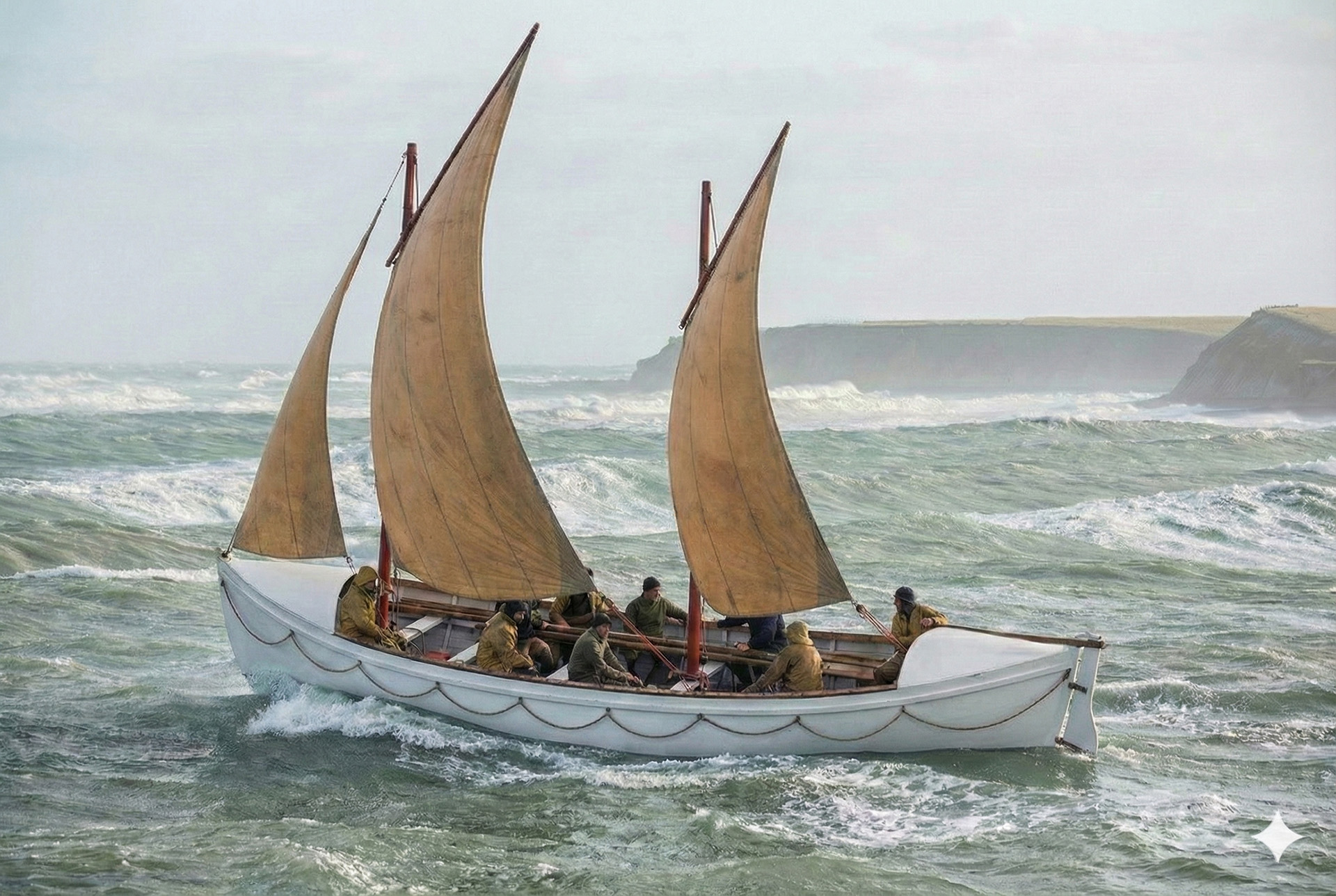
AI recreation of the Alexandra rigged with her two-masted dipping lug configuration off Timaru's coast near Mutu Mutu. While the boat was built as a "Pulling-and-Sailing" (P&S) lifeboat with removable masts and natural canvas sails, this scene represents what the boat could do, not what it normally did. Across 22 years of operational service and dozens of documented rescues, sailing is mentioned only once in contemporary newspaper accounts.-the 1864 fire of the schooner Herald where she sailed about 12 miles with a favourable south-easterly wind. Timaru's exposed roadstead, onshore storm conditions, and the boat's shallow 4½-inch keel made rowing—not sailing—the Alexandra's true operational mode.
The Sailing Rig: A Capability Rarely Used
The Missing Evidence: Almost Never Mentioned
The Alexandra was designated a "Pulling-and-Sailing" (P&S) lifeboat by the Royal National Lifeboat Institution, equipped with both oars and a two-masted sailing rig. Yet across 22 years of operational service (1863-1885) and dozens of documented rescues in Papers Past and contemporary accounts, sailing is found mentioned only once—the 1864 rescue of the schooner Herald, where the Alexandra sailed approximately 12 miles with a favorable south-easterly wind.
Every other major rescue description consistently refers to the boat being "manned by seven oarsmen," "pulled by oars," or "rowed out to the wreck." This near-total absence of sailing references reveals a fundamental truth about Timaru rescue operations: the Alexandra's sailing rig was a theoretical capability that proved largely irrelevant to the boat's actual mission.
The Technical Configuration
Two-Masted Dipping Lug Rig
The Alexandra carried the standard RNLI pulling-and-sailing configuration:
- Two unstayed masts: Stepped in tabernacles (hinged deck fittings) allowing quick raising or lowering
- Dipping lugsails: Four-sided working sails with the yard extending forward of the mast
- Natural canvas sails: Tan/buff colored flax canvas, typical for institutional boats of the era
- Running rigging only: Halyards (to raise the yards and sails) and sheets (to control sail angle)—no permanent standing rigging like shrouds or stays
- Removable configuration: Masts could be completely struck (lowered or removed) for rowing operations
Design Advantages
This rig offered several benefits suited to volunteer lifeboat operations:
- Simplicity: No complex rigging or stay adjustment required
- Quick deployment: Sails could be set in minutes if needed
- Low weight aloft: Unstayed masts kept the center of gravity low, preserving the critical self-righting mechanism
- Dual-purpose fittings: Tabernacles served as Samson posts for anchor work when masts were struck
- Compatibility with rowing: Boat could be rowed and sailed simultaneously if conditions allowed
The Keel Problem: Why She Couldn't Sail to Windward
The Alexandra's shallow keel was her greatest sailing limitation. At just 4½ inches total depth (3-inch by 2½-inch iron section plus 3½-inch by 2-inch wooden section), with a 6-foot beam and flat-bottom construction, the boat had virtually no lateral resistance under sail.
The Physics of the Problem
When attempting to sail toward the wind (beating to windward), a boat needs lateral resistance from the keel to counteract the sideways push of the wind. Without this resistance, the boat "makes leeway"—sliding sideways nearly as fast as it moves forward. The Alexandra's shallow keel meant:
- Dramatic leeway when close-hauled (sailing into the wind)
- Inability to point high (sail close to the wind direction)
- Effective sailing only when reaching (wind from the side) or running (wind from behind)
Why This Design?
The shallow draft was entirely deliberate. The keel depth that would improve sailing performance would have prevented the boat from reaching vessels wrecked in the surf zone—precisely where most Timaru rescues occurred. The Alexandra was designed for surf work and self-righting, not sailing efficiency.
Operational Reality: Why Rowing Dominated
Timaru's Geographic Constraints
Timaru's exposed roadstead created conditions fundamentally unsuited to sailing rescue operations:
- No sheltered harbor: All shipping anchored in open sea, exposed to prevailing swells
- Wrecks in onshore gales: Ships typically wrecked when blown onto the coast—meaning rescue required beating directly into the wind
- Shallow-water operations: Vessels grounded close to shore, in the breaking surf where the Alexandra's shallow draft was essential
- Short distances: Most rescues were within a mile or two of the boat shed—rowing distance, not a sailing passage
Operational Priorities
The nature of lifeboat work in Timaru favored oars over sails:
- Speed of response: Getting oars in the water was faster than rigging masts and sails
- Surf launch: Breaking through heavy surf required concentrated rowing power and precise boat control
- Directional control: Rowing provided the precision maneuvering needed to approach wrecks in confused seas
- Wind direction: When ships wrecked in storms, the wind was typically blowing onshore—the exact direction the Alexandra needed to sail against
- Return journey: By the time rescue was complete, conditions often moderated—but rowing remained faster and more reliable
The Single Documented Instance
The only newspaper mention of the Alexandra sailing is from the Christchurch Press, January 25, 1864, during the rescue of the schooner Herald. The boat sailed approximately 12 miles with a favorable south-easterly wind—calm conditions where the rig's capabilities could actually be used. This appears to be the sole operational use of the sailing rig across the boat's entire 22-year service life.
What The Historical Silence Tells Us
The absence of sailing references in operational accounts is striking. Newspaper reporters loved technical detail and dramatic description. If the Alexandra had regularly sailed to rescues, this would have been reported. Instead, every account describes:
- "Manned by seven oarsmen"
- "Pulled by oars through heavy seas"
- "Rowed out to the wreck"
- "Seven oars and a steering sweep"
This consistent language reveals the operational truth: the Alexandra was a rowing lifeboat that happened to have sails, not a sailing vessel that could be rowed in calm conditions.
Historical Reference: RNLI Lifeboats Under Sail
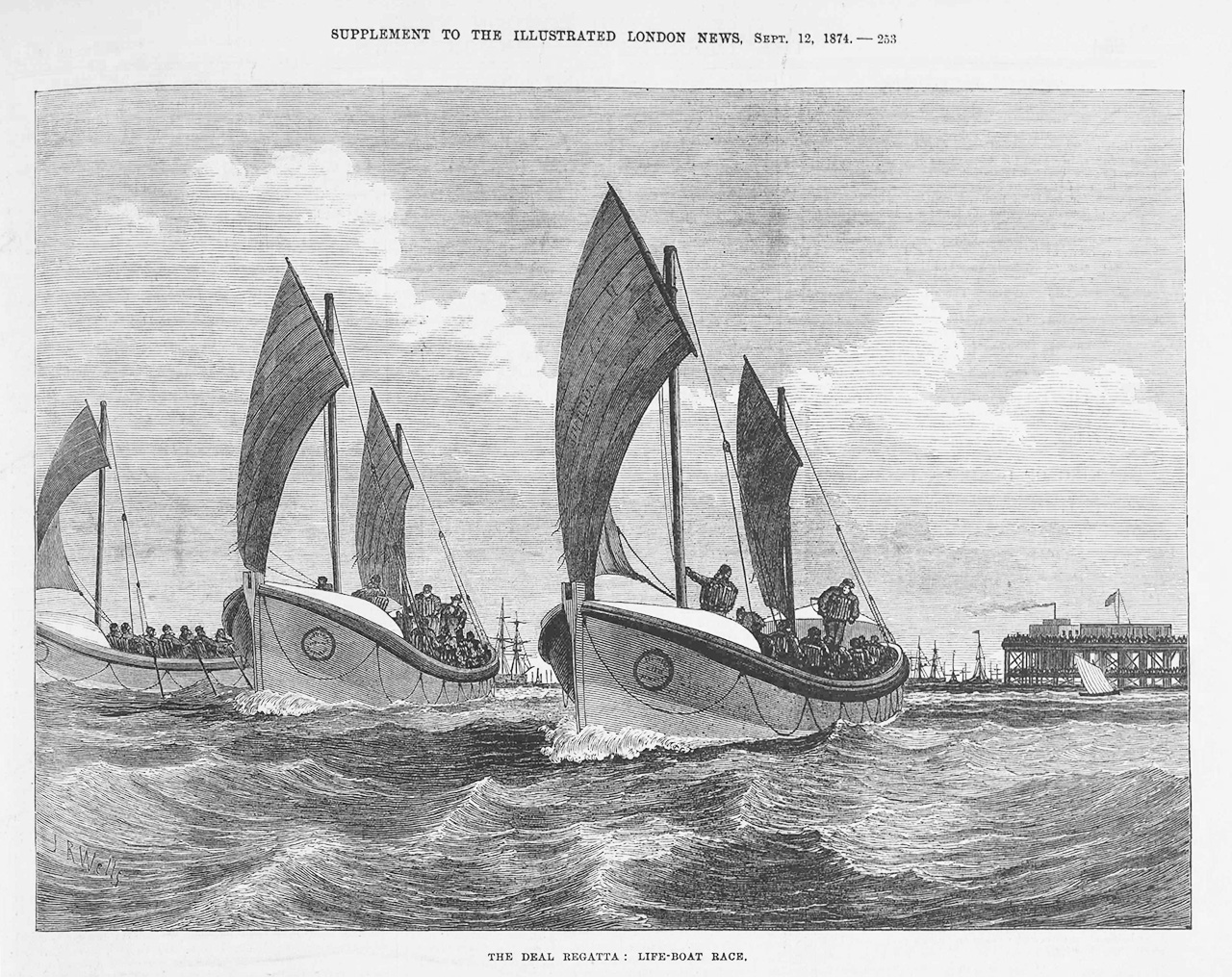
Illustrated London News, September 12, 1874
RNLI lifeboats racing under sail at Deal, showing the standard pulling-and-sailing configuration with dipping lug rigs that the Alexandra carried. These boats demonstrate the sailing capability built into all RNLI P&S lifeboats of the era—two unstayed masts with four-sided lugsails, crews managing sheets and halyards, boats making good speed in favorable conditions.
This is what the Alexandra would have looked like on that single documented occasion in 1864 when she sailed to the Herald rescue with a favourable south-easterly wind. The illustration shows why the RNLI standardized on this rig: it worked brilliantly in British waters where stations had sheltered harbours, varied wind conditions, and longer passages to wrecks. But Timaru's exposed roadstead, onshore gales, and shallow-draft requirements meant these sailing capabilities—so effective at Deal—went almost entirely unused on New Zealand's South Island coast.
Note the similarity in hull form to the Alexandra: the characteristic self-righting shape, the cork fenders along the gunwales, the crew positions, and the overall proportions of the Peake-class design. The main difference? These British boats were actually sailing regularly. The Alexandra carried the same rig but relied on her seven oars instead.
Source: British Newspaper Archive
The Engineering Context: Standard RNLI Specification
The sailing rig wasn't wasted investment—it was standard RNLI specification for all P&S boats. The Alexandra was built to a proven template that worked brilliantly in British waters, where stations had:
- Sheltered harbours allowing sail deployment before launch
- Varied wind conditions including offshore winds
- Longer passages to wrecks (sometimes 5-10 miles)
- Deeper-draft boats that could sail more effectively
What Timaru's experience demonstrates is how profoundly local conditions could make certain standard capabilities irrelevant. The boat's self-righting mechanism, self-bailing valves, and rowing configuration proved essential and were used in every rescue. The sailing rig? It came with the package, but Timaru's rescues were won by human muscle and oar power, not canvas and wind.
Theoretical Use Cases
The sails might theoretically have been useful for:
- Reaching or running: Wind from the side or behind, where shallow keel mattered less
- Return passages: After rescue, if wind had shifted offshore and crew was exhausted
- Extended searches: Covering large areas in moderate conditions looking for vessels in distress
- Relief to crew: Reducing rowing load on longer operations
But Timaru rescues rarely fit these scenarios. Vessels wrecked close inshore during onshore storms, requiring immediate rowing response and precision maneuvering that sails couldn't provide.
The Rigging Details
The Alexandra's sailing hardware—steps, eyebolts, locking pins, and halyard fittings—survives as physical evidence of capabilities designed for but probably rarely used. The detail photographs below show these fittings as they appear on the restored boat, testament to RNLI engineering standards that prioritized versatility even when local conditions made some capabilities redundant.
Technical Details: Steps and Rigging Hardware
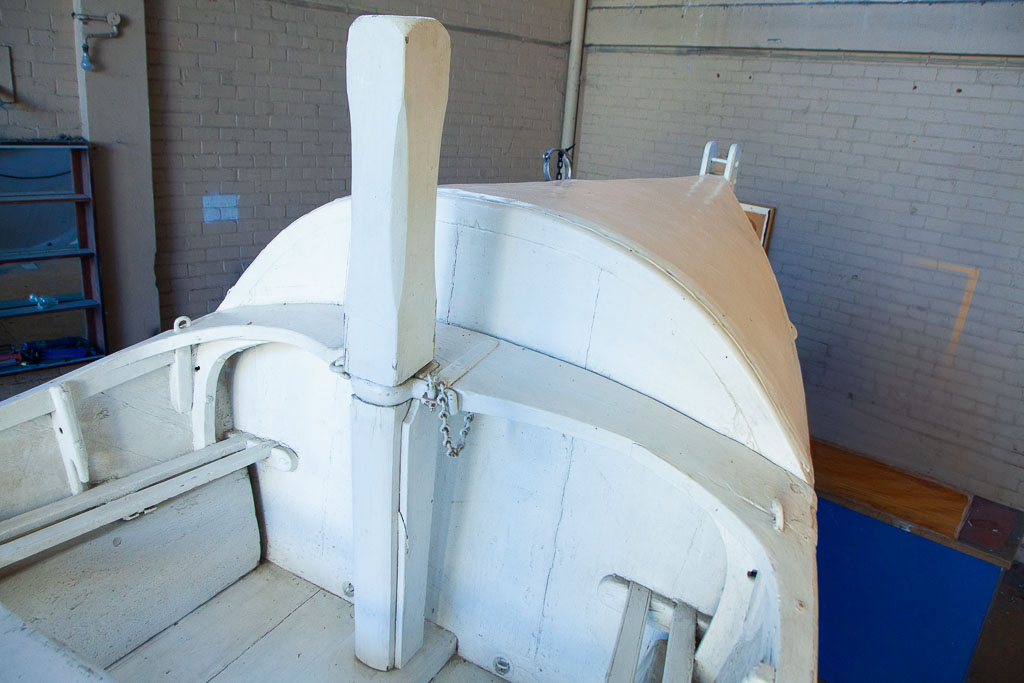
When struck, this robust post served as a Samson post for securing anchor cables and tow lines. For sailing, this was replaced and the step provided a place to slide in the heel of the mast and structurally support it. This dual-purpose design eliminated redundant fittings and saved precious weight. Eyebolts to the left and right were used as parts of halyard system.
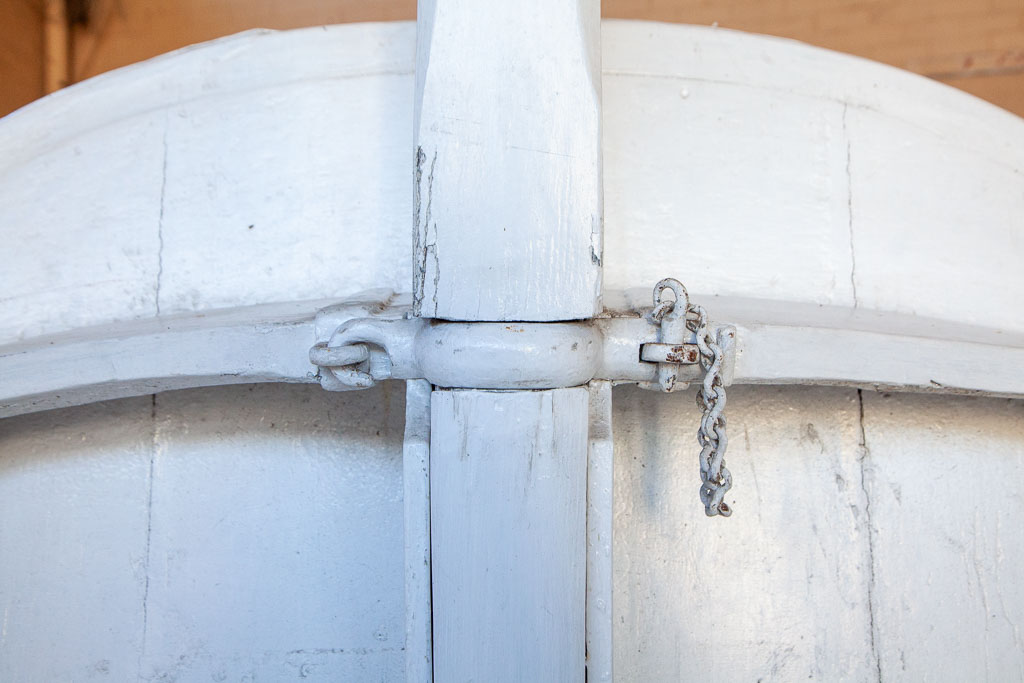
Once the mast was placed, this removable pin locked it in through aligned holes in the step and mast heel. The pin is permanently chained to the fitting. In the chaos of rough seas, a loose pin could be lost overboard, leaving the mast unsecured. The retention chain meant crews always had the pin immediately at hand—fool-proof RNLI engineering for emergency operations.
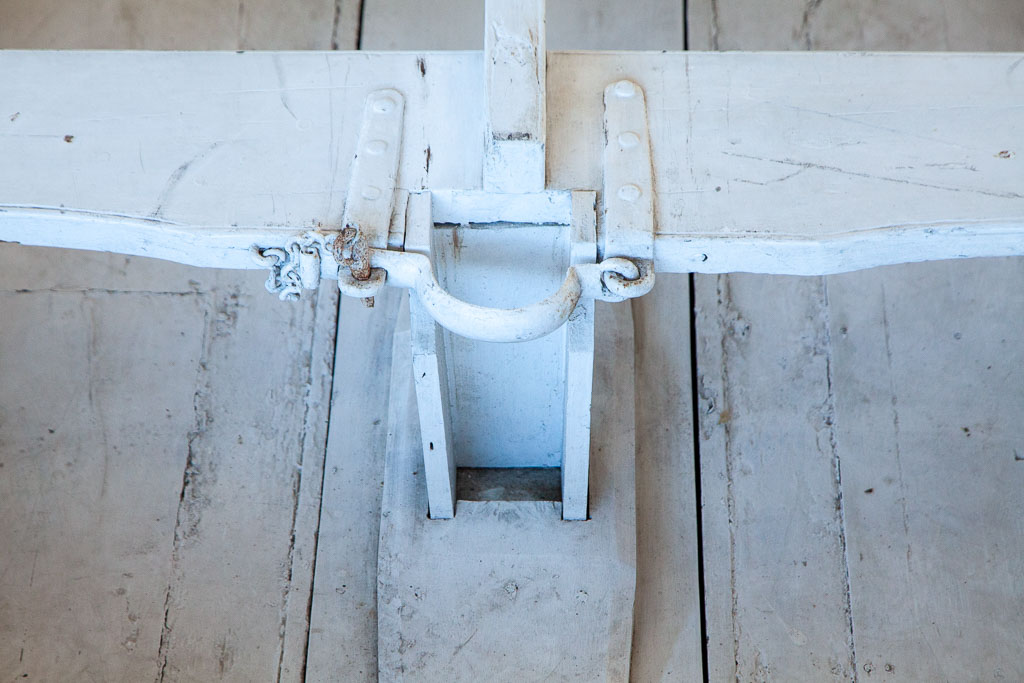
The U-shaped hinge pin secured the aft mast. The robust timber construction handled both sailing loads and heavy anchor work in Timaru's exposed roadstead.
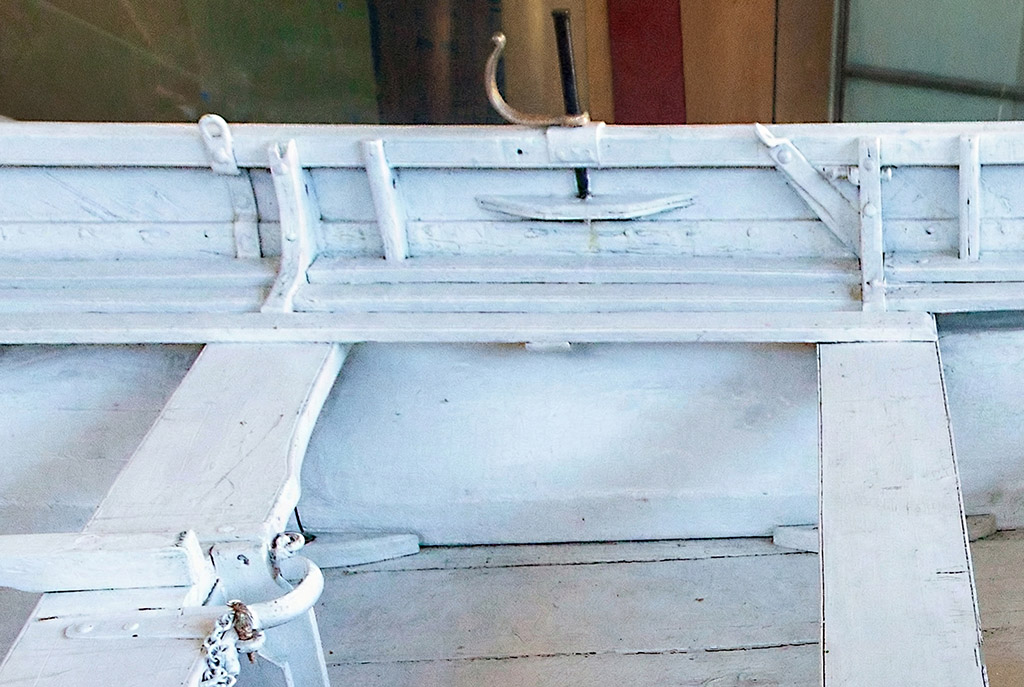
Strategically-spaced eyebolts along the gunwale served multiple functions: sheet leads for controlling sail angle, attachment points for life-lines (grab loops for people in the water), and securing points for rescue lines. Though designed primarily for sail handling, these fittings saw far more use for life-saving equipment than for sailing operations during the Alexandra's 22-year service.
Conclusion: Engineering vs. Reality
The Alexandra succeeded because it was rowed. The sailing rig—sophisticated, well-engineered, standard RNLI equipment—went essentially unused not because it was poorly designed, but because Timaru's operational reality made it irrelevant. The engineering that mattered was the iron keel providing self-righting capability, the cork ballast ensuring buoyancy, the drainage valves keeping the boat operational when swamped, and the double-diagonal hull construction that could withstand impacts that would shatter conventional boats.
The masts, sails, yards, and rigging? They came with the boat. But on May 14, 1882, when the Alexandra capsized four times and self-righted each time, it wasn't sail handling that kept the boat functional—it was the strength and skill of volunteer oarsmen pulling seven long oars through mountainous seas.
The Alexandra's sailing rig stands as evidence of how even the best engineering can be rendered irrelevant by local conditions. The RNLI built versatile boats; Timaru's exposed roadstead demanded specialists in rowing through surf. The capability existed. The need did not.