Self-Righting Lifeboat Technology
Introduction: Born from Tragedy
The Alexandra lifeboat that served Timaru from 1863 to 1885 was built to Royal National Lifeboat Institution (RNLI) specifications during a revolutionary period in maritime rescue technology. To understand the Alexandra's design and capabilities, we must first understand the crisis that gave birth to self-righting lifeboats.
The Self-Righting Revolution (1850s–1860s)
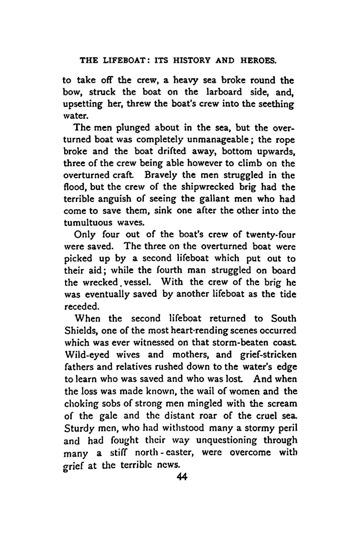
The 1849 disaster prompted the RNLI to hold a competition for the best lifeboat design. Two key innovators emerged:
James Beeching designed the first self-righting lifeboat using water ballast that could be admitted into a tank at the bottom after launching, combined with raised air-cases at bow and stern. His 36-foot boat was tested at Brighton in February 1852 in rough seas and proved the concept.
James Peake (assistant master-shipwright at Woolwich Dockyard) refined Beeching's design, creating the standardized RNLI self-righting lifeboat that became the template for boats like the Alexandra.
Mass Production Era: Messrs. Forrest of Limehouse constructed approximately 160 self-righting lifeboats to RNLI specifications—about 40 for foreign governments and British colonies (including New Zealand's Alexandra), and 120 for British stations.
The Alexandra arrives in Timaru—one of the first RNLI-spec lifeboats in the Southern Hemisphere, representing the cutting edge of maritime rescue technology.
How Self-Righting Technology Works
The RNLI self-righting design combined multiple engineering principles to create a boat that would automatically return to upright position after capsizing. Holmes' 1900 account provides the technical details:
Core Design Features:
- 1. Watertight Deck (Air Chamber)
- A complete watertight deck or "false bottom" extending to the waterline when loaded, providing massive buoyancy. This air chamber could keep the boat afloat even if the upper sections filled with water.
- 2. Detached Air-Cases Along Sides
- Multiple sealed air compartments running along both sides from the deck to the rowing thwarts, distributing buoyancy evenly and providing redundancy if one section was damaged.
- 3. Large End Air-Cases
- Substantial air-cases (5-6 feet long) built into bow and stern, extending above the deck level. These created the righting moment by providing high buoyancy at the ends.
- 4. Heavy Iron Keel and Water Ballast
- A weighted iron keel provided a low center of gravity. Water ballast tanks could be filled after launching to further lower the center of gravity and increase stability.
- 5. Self-Bailing System
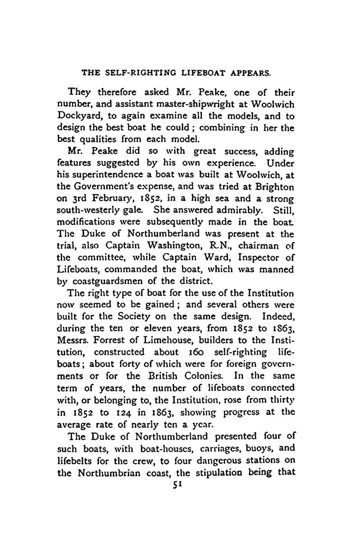
- Six or more relieving tubes (non-return valves) fitted through the deck allowed water to drain out automatically when the boat righted itself, without letting seawater in from below.
- 6. Cork Fenders
- External cork cladding (approximately 2 feet 3 inches deep) around the hull provided additional flotation and protected the wooden hull from impact damage.
The Physics of Self-Righting
When capsized, the heavy iron keel and water ballast pull downward while the large air-cases at bow and stern (now underwater) push upward with tremendous buoyant force. This creates a powerful righting moment that rolls the boat back upright—usually within seconds. The elevated end air-cases are crucial: they ensure that even if capsized, the boat's center of buoyancy shifts dramatically off-center, generating the torque needed to flip the boat back over.
The Alexandra's Specifications
While precise construction records for the Alexandra haven't survived, contemporary RNLI self-righting boats of the early 1860s typically had these specifications:
- Length
- 32-34 feet overall
- Beam
- 8-10 feet
- Depth
- 3.5-4 feet amidships
- Propulsion
- 10-14 oars, double-banked
- Steering
- Long steering oar at each end (bow and stern)
- Crew Capacity
- 12-16 oarsmen plus coxswain
- Rescue Capacity
- Could carry 40-50 persons in calm conditions
- Construction
- Planked wooden hull with iron frames, cork fenders, watertight compartments
- Weight
- Approximately 3-4 tons fully equipped
Proven Performance: The Statistics
RNLI Self-Righting Boats: 1852-1899
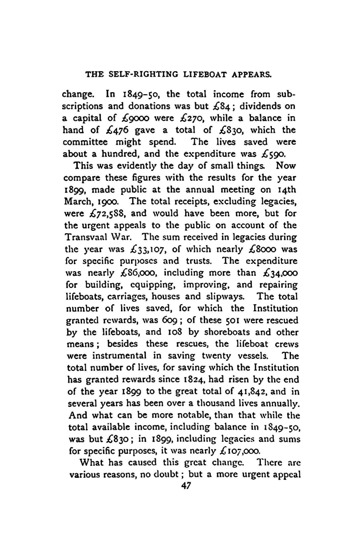
- 244 boats in service by 1899
- ~9,000 launches on rescue service in 45 years
- 16,000+ lives saved directly
- 56 capsizes during service calls
- 28 capsizes with loss of life (50% survival rate even in capsize events)
- 28 capsizes with no loss of life (self-righting system saved the crews)
Varieties of RNLI Lifeboats (c.1900)
By the time Holmes wrote in 1900, the RNLI operated eight different lifeboat types, each adapted for specific coastal conditions. The variety demonstrates the sophistication of late Victorian maritime engineering:
| Type | Key Features | Station Examples |
|---|---|---|
| Self-Righting (Standard) | Original Peake design, most common | 244 stations by 1899 |
| Non-Self-Righting | Lower profile, greater rowing speed | Calmer waters |
| Liverpool Type | Broader beam (35ft × 9ft), heavy keels | Liverpool, Holyhead |
| Watson Type | Various sizes (30-45ft), water ballast | Southport, Poole, Bournemouth |
| Steam Lifeboats | Screw-driven, 50-60ft, mechanical power | Holyhead, New Brighton, Harwich |
| Pulling & Sailing | Combined rowing and sail rig | Mixed service stations |
The Alexandra was a standard self-righting type of the early 1860s design—proven, reliable, and appropriate for Timaru's exposed roadstead conditions.
The "Death Trap" Myth: Setting the Record Straight
Myth vs. Reality
The Myth: The Alexandra was a "death trap" and poor design that endangered crews.
The Reality: The Alexandra was state-of-the-art RNLI technology, identical to boats successfully saving lives across Britain and the colonies. Its four self-rightings on Black Sunday vindicated the design exactly as intended.
The "death trap" narrative appears to have emerged decades after the Alexandra's service ended, likely conflating several separate issues:
Sources of Confusion:
- 1. Misunderstanding Capsizing
- Modern observers saw "capsized four times" and assumed failure. In fact, capsizing and self-righting was the design working as intended—the boat returned upright each time, allowing rescue work to continue.
- 2. Conflating Different Incidents
- The five deaths on Black Sunday occurred during the salvage phase (attempting to board listing ships), not during lifeboat operations. The lifeboat itself performed heroically during the rescue phase.
- 3. Anachronistic Standards
- Judging 1860s technology by modern standards. For its era, the self-righting lifeboat was revolutionary and represented the best available rescue technology.
- 4. Loss of Technical Knowledge
- By the mid-20th century, few people understood how self-righting boats worked or why capsizing was an acceptable operational risk given the alternative (drowning crews in non-self-righting boats).
Contemporary Assessment
"The crews need no longer have a misgiving about their safety; that a thoroughly good lifeboat has been obtained... if properly handled, need not fear to face any weather or sea."
This was the professional assessment from Britain's leading maritime rescue organization—the same organization that designed and built the Alexandra. Holmes' 1900 account reinforces this: self-righting boats were praised as safety innovations, not condemned as death traps.
The Alexandra in Context: Colonial Maritime Rescue
The Alexandra's arrival in Timaru in 1863 placed New Zealand at the forefront of colonial maritime safety. Consider the comparative timeline:
Global Context
- Britain (1863): 124 RNLI lifeboats in service
- Australia (1863): Limited local lifeboats, mostly non-RNLI designs
- New Zealand (1863): The Alexandra—an RNLI-spec professional lifeboat
- United States (1863): U.S. Life-Saving Service not established until 1871
Timaru's investment in professional rescue equipment—a complete RNLI-specification lifeboat, boat house, and carriage—represented sophisticated understanding of maritime safety and willingness to adopt the best available British technology. The subsequent addition of the Boxer rocket apparatus (1867) created an integrated rescue system matching or exceeding capabilities at many British ports.
Legacy and Significance
The Alexandra is one of only three surviving self-righting lifeboats worldwide from this pioneering era. Its preservation matters because:
- Historical Evidence
- Physical proof of 1860s RNLI technology and construction methods
- Engineering Achievement
- Demonstrates Victorian maritime engineering at its finest—elegant solution to capsizing through physics and materials science
- Colonial Technology Transfer
- Shows how British innovations spread to colonies, adapted to local conditions (Timaru's exposed roadstead)
- Myth Correction
- Physical evidence helps counter the "death trap" narrative—visitors can see the robust construction, cork fenders, air compartments, and self-bailing system
- Human Story
- Connects to Captain Mills and volunteer crews who trusted their lives to this technology—and whose courage was validated when it worked exactly as designed on Black Sunday
Conclusion: Victorian Engineering Excellence
The self-righting lifeboat represents one of Victorian Britain's greatest contributions to maritime safety. Born from tragedy in 1849, refined through engineering competition and practical testing, and deployed globally by the 1860s, these boats saved tens of thousands of lives over decades of service.
The Alexandra embodied this technology at its peak. Its 22 years of service in Timaru (1863-1885), including the vindication of its design on Black Sunday 1882, demonstrate that far from being a "death trap," it was exactly what its designers intended: a boat that could face the worst conditions, capsize if necessary, right itself automatically, and allow crews to continue their lifesaving work.