Building the Alexandra
Introduction: Where Lifeboats Were Born
The Alexandra lifeboat was constructed around 1863 to RNLI specifications by one of the approved builders of the era. While we don't have the specific builder's records for the Alexandra, we know it was built to the same exacting standards that governed all RNLI lifeboats of the period.
F.M. Holmes' 1900 account takes us inside the Thames Ironworks and Shipbuilding Company at Blackwall—one of the primary RNLI builders in the 1890s—where he documented the construction process in detail. The methods he describes would have been essentially the same as those used to build the Alexandra thirty years earlier, as RNLI construction standards were well-established by the 1860s.
The Birthplace of Lifeboats
"From the sheds behind resounds the noise of hammers, though not with such a din as in another department of the works close by, where hundreds of men are at work on the sides of a huge steel-plated ship; and through openings in the sheds you catch glimpses of the same bright blue and white of the lifeboats, and see skeletons and sides of the boats in various stages of construction."
By the 1850s-1860s, lifeboat construction had become a specialized craft. The RNLI worked with approved builders—primarily Messrs. Forrest of Limehouse during the Alexandra's era—who constructed boats to exact specifications. Between 1852 and 1863, approximately 160 self-righting lifeboats were built, with about 40 destined for foreign governments and British colonies like New Zealand.
Materials: Victorian Engineering Choices
Every material in an RNLI lifeboat was selected for specific performance characteristics. Holmes explains the reasoning behind each choice:
Primary Construction Materials:
- Mahogany (Hull Planking)
- "A very sound and hard wood" used for the two-skin diagonal planking system. Steamed to make it pliable for bending during construction. The diagonal arrangement meant planks ran from keel to gunwale at opposing angles, creating a lattice of strength.
- Elm (Keel and Keel Plank)
- "A durable wood and able to withstand the alternations of being wet and dry." Used for the main keel structure that took the most punishment from beaching and launching.
- Pine (Air-Cases)
- Lighter wood suitable for buoyancy compartments. Easier to work for the complex curved structures at bow and stern.
- Iron (Keel, Frames, Fittings)
- Heavy iron ballast keels provided low center of gravity. Iron frames gave structural rigidity. All metal fittings (rowlocks, towing rings, etc.) were iron or brass.
- Cork
- External cork fenders (approximately 2 feet 3 inches deep) provided additional flotation and protected the wooden hull. Cork was also used in lifebelts for crew.
- Canvas/Calico
- Placed between the two mahogany skins with glue, then "ironed even as a laundry-maid would smooth out her linen." This created a waterproof laminate that added strength and flexibility.
- Glue and Varnish
- Marine-grade adhesives bonded the laminated hull layers. Black varnish sealed water-ballast tanks.
Why Mahogany?
Mahogany was expensive but essential. Its hardness resisted impact damage from debris and rocks, its fine grain minimized water absorption, and it could be steamed and bent into the complex curves required for lifeboat hulls. Most importantly, it was strong enough to support the diagonal planking system that made RNLI boats so durable.
The Construction Process
Holmes documented the step-by-step process that would have been followed for the Alexandra:
Building Sequence:
- Design and Plans: "From the Lifeboat Institution have come all the plans and designs of the boat. Everything is depicted first on paper... Photographs of these are taken in white lines on a blue ground, and are of a more convenient size for carrying hither and thither about the sheds."
- Laying the Keel: "The keel of one lying on its blocks, like a long rib of wood, bent upward at the end. Above the keel, and extending a few inches on either side of it lengthways, projects a thick plank, and from this keel and plank spring the sides."
- Setting the Moulds: "Cross-section wooden frames, which are afterwards cut away or removed, but around which the side-planking or the skin of the boat is to be placed." These temporary forms ensured the hull shape matched the plans exactly.
- First Skin Application: Mahogany planks were steamed in a long steam case outside the sheds to make them pliable, then bent and fastened diagonally around the moulds. "The mahogany planks are steamed to make them pliable."
- Canvas Lamination: "When the first skin or mahogany planks is in place they are covered with glue, and the calico is then stretched over them and ironed even as a laundry-maid would smooth out her linen."
- Second Skin Application: "Over this prepared canvas the second skin or layer of planks is laid"—at opposing diagonal angle to the first skin, creating the characteristic X-pattern of strength.
- Internal Frames: "There are further a number of inner supports or 'frames,' seventeen or eighteen of them in a boat forty-three feet long." These permanent ribs tied the structure together.
- Deck and Thwarts: "The boat has three continuous ribs running lengthwise from stem to stern—one for the deck, one for the thwarts or seats, and one at the top for the gunwale."
- Air-Cases Construction: "The air-cases are covered in a similar manner with glue, over which calico is stretched and ironed." Separate watertight compartments (not less than 15 cubic feet each) were built and installed.
- Water-Ballast Tanks: For self-righting boats, narrow central tanks ran along the keel. "The tanks have been covered with black varnish to hold water; in another boat close by, the tanks are filled with water in order to test their water-tight construction."
- Self-Bailing Valves: "Eight or more relieving tubes" (non-return valves) were fitted through the deck to allow water to drain out automatically.
- Cork Fenders: External cork cladding was applied around the hull for additional buoyancy and impact protection.
- Painting: The distinctive RNLI blue and white paint scheme—white hull with blue wales (horizontal bands).
- Fitting Out: Installation of rowlocks, towing rings, mast steps, lifelines, and all operational equipment.
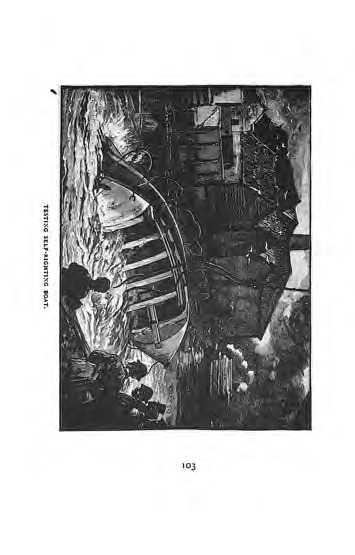
- Testing: At the RNLI storeyard: "We can pick them up there, and swing them over the water and drop them down. Then we pull them over with a parbuckle and see if they will right themselves. We fill them up with deadmen and see if they float properly."
The Revolutionary Diagonal Planking
Why Diagonal Construction Mattered
The double-skin diagonal planking system was one of the RNLI's most important innovations:
"The sides of a lifeboat are constructed probably in a different manner from that of any other craft afloat... the planks spring upwards, as it were, from the keel to the gunwale... in a diagonal direction. Thus the two layers of planks on the boat's side resemble a series of diagonal crosses or X's, the planks of the crosses being laid closely side by side, and thus it is almost impossible for one plank to be started out of its position by the heavy blows of the rough sea."
Traditional Boat Construction: Planks ran lengthwise (parallel to the keel) from bow to stern. A single impact could split a plank along its length, causing catastrophic leaks.
RNLI Diagonal System: Each layer ran at 45-degree angles, with layers crossing each other. Any impact hit multiple planks at different angles, distributing the force. Even if one plank cracked, the opposing layer and canvas laminate maintained structural integrity.
Result: "A piece of the planking may be smashed or beaten in, but the chances of leakage and of successful attack upon any single plank are greatly diminished."
The Complete Equipment Package
Holmes visited the RNLI storeyard and documented the comprehensive equipment supplied with every lifeboat. The Alexandra would have arrived in Timaru with all of this:
Nearly 220 Different Items Required
Propulsion & Control: Oars of ash and fir (10-14 rowing oars double-banked), sweep oars for steering assistance, steering oar at each end, masts and sails, compasses with candles to illuminate them
Anchoring & Mooring: Metal anchors (56-112 lbs), light grapnels (5 lbs), various chains, rope cables (twisted Italian hemp and Yacht Manila), steel wire cable, drogue (sea-anchor—"canvas bag that grips the water, very useful in keeping a boat's head to the sea")
Rescue Equipment: Heaving canes with lines ("life-preserver" shape for throwing to wrecks), line tubs for coiled rope ready to run out, lifebuoys and lifebelts with cork, lifelines in festoons around sides, grappling hooks
Survival Gear: Provisions box, beach lanterns and hand lanterns, matches in waterproof containers, distress signals
Launch & Recovery: Boat carriage with wheels, skids (single, double, and roller types) for sliding over sand/shingle, turn-table for positioning, harness for horses, cart grease for lubrication
Maintenance Tools: Shovels, hatchets, axes, marline spikes, spanners, various blocks for running ropes
Boathouse Equipment: Door locks and keys, boat flags, stationery for recording service
Quality Control: "All the ropes and chains are tested by hydraulic power, the trial to which they are subjected being the enormous strain of ten tons. They have to play their part in rough and stormy weather which will try their quality even to breaking point, and lives may hang upon their strength and endurance."
Testing and Quality Assurance
Before any RNLI lifeboat entered service, it underwent rigorous testing at the Poplar storeyard:
Testing Procedures:
- Lifting Test: "We can pick them up there"—using a crane with a strong arm and weighing floor to check structural integrity under lifting forces
- Capsize Test: "Swing them over the water and drop them down. Then we pull them over with a parbuckle and see if they will right themselves"—ensuring the self-righting mechanism worked properly
- Buoyancy Test: "We fill them up with deadmen [weights] and see if they float properly"—verifying the air-cases provided sufficient flotation
- Load Test: "Load them up to the gunnel with heavy weights, and test them in every possible way"—checking maximum capacity and stability
- Water Trials: Rowing tests in the Lea Canal to check handling, speed, and maneuverability
- Watertight Tests: Water-ballast tanks filled and inspected for leaks; air-cases checked for seal integrity
Only after passing all tests would a boat be painted in RNLI colors, equipped with the full complement of gear, and shipped to its station—in the Alexandra's case, a long sea voyage to New Zealand.
The Alexandra's Journey to Timaru
After construction and testing in England (probably 1862-1863), the Alexandra faced a journey of approximately 12,000 miles to New Zealand. Lifeboats were typically shipped as deck cargo on commercial vessels, secured firmly to prevent damage during the voyage.
Colonial Export Standard
The fact that the Alexandra was one of "about forty" RNLI lifeboats built for foreign governments and British colonies between 1852-1863 demonstrates Timaru's commitment to adopting the best available maritime safety technology. Many larger colonial ports still relied on converted local boats or inferior designs, while Timaru invested in a purpose-built RNLI-specification lifeboat.
Upon arrival in Timaru, the Alexandra would have required:
- Construction of a proper boat house to protect it from weather
- A suitable carriage for beach launching
- Rails or skids for launching down the beach
- Organization of a trained volunteer crew
- Establishment of watch and alarm systems
All of this infrastructure was in place by 1863, making Timaru's lifeboat service one of the most professional in the colonial Pacific.
Maintenance and Longevity
RNLI lifeboats were designed for long service lives with proper maintenance. Holmes notes that boats regularly served 20-30 years before replacement. The Alexandra's 22-year service (1863-1885) was entirely typical.
Required Maintenance:
Daily: Visual inspection by superintendent, checking for damage, ensuring equipment was complete and properly stowed
Weekly: Airing out boat house, checking line condition, testing drain valves
Monthly: Exercise launches when possible, rope and chain inspection, testing air-case integrity
Annually: Repainting, varnishing water-ballast tanks, replacing worn ropes and equipment, inspecting frames and planking
After Service: Thorough inspection after every launch, repair of any damage, replacement of lost or damaged equipment
The RNLI provided replacement parts and equipment through their storeyard system. New rope, paint, canvas, cork, and other consumables could be ordered by the local lifeboat secretary and shipped from London. This support network meant colonial boats like the Alexandra could be maintained to the same standards as British stations.
Why Construction Details Matter
Understanding how the Alexandra was built helps explain its performance on Black Sunday 1882:
Four Capsizes
The diagonal planking absorbed massive wave impacts without splitting. The double-skin laminated construction maintained structural integrity even under extreme stress.
Four Self-Rightings
The heavy iron keel, precisely-sized air-cases, and calculated center of gravity worked exactly as designed. Each time the boat flipped over, physics brought it back upright.
Continued Service
The self-bailing valves cleared water automatically. The robust construction allowed the crew to resume rowing and continue rescue efforts immediately after each capsize.
24 Rescued
The boat's capacity (40-50 persons in calm conditions) meant it could ferry multiple trips. The comprehensive equipment—lines, grapples, oars—provided multiple rescue options.
Victorian Engineering Triumph
The Alexandra wasn't lucky on Black Sunday—it was well-engineered. Every material choice, every construction technique, every piece of equipment had been refined through decades of RNLI experience and hundreds of successful rescues. The boat performed exactly as its designers at Woolwich Dockyard and its builders at Limehouse intended.
The Alexandra as Historical Artifact
As one of only three surviving self-righting lifeboats from this era, the Alexandra preserved in Timaru represents:
- Construction Techniques: Visible evidence of diagonal planking, laminated construction, and Victorian boatbuilding craftsmanship
- Material Science: Examples of mahogany, elm, cork, iron, and canvas materials selected for specific properties
- Engineering Solutions: Self-righting air-cases, water-ballast tanks, and self-bailing valves demonstrating applied physics
- Industrial Standardization: RNLI specifications that allowed consistent quality across hundreds of boats
- Colonial Technology Transfer: Evidence of British maritime innovations reaching the Pacific
Researchers, maritime historians, and engineering students can study the Alexandra to understand how Victorian society solved complex technical challenges. The boat is a three-dimensional textbook of 1860s materials science, hydrodynamics, and manufacturing.
