The People
Crews & Volunteers Who Saved Lives | 1858-1892
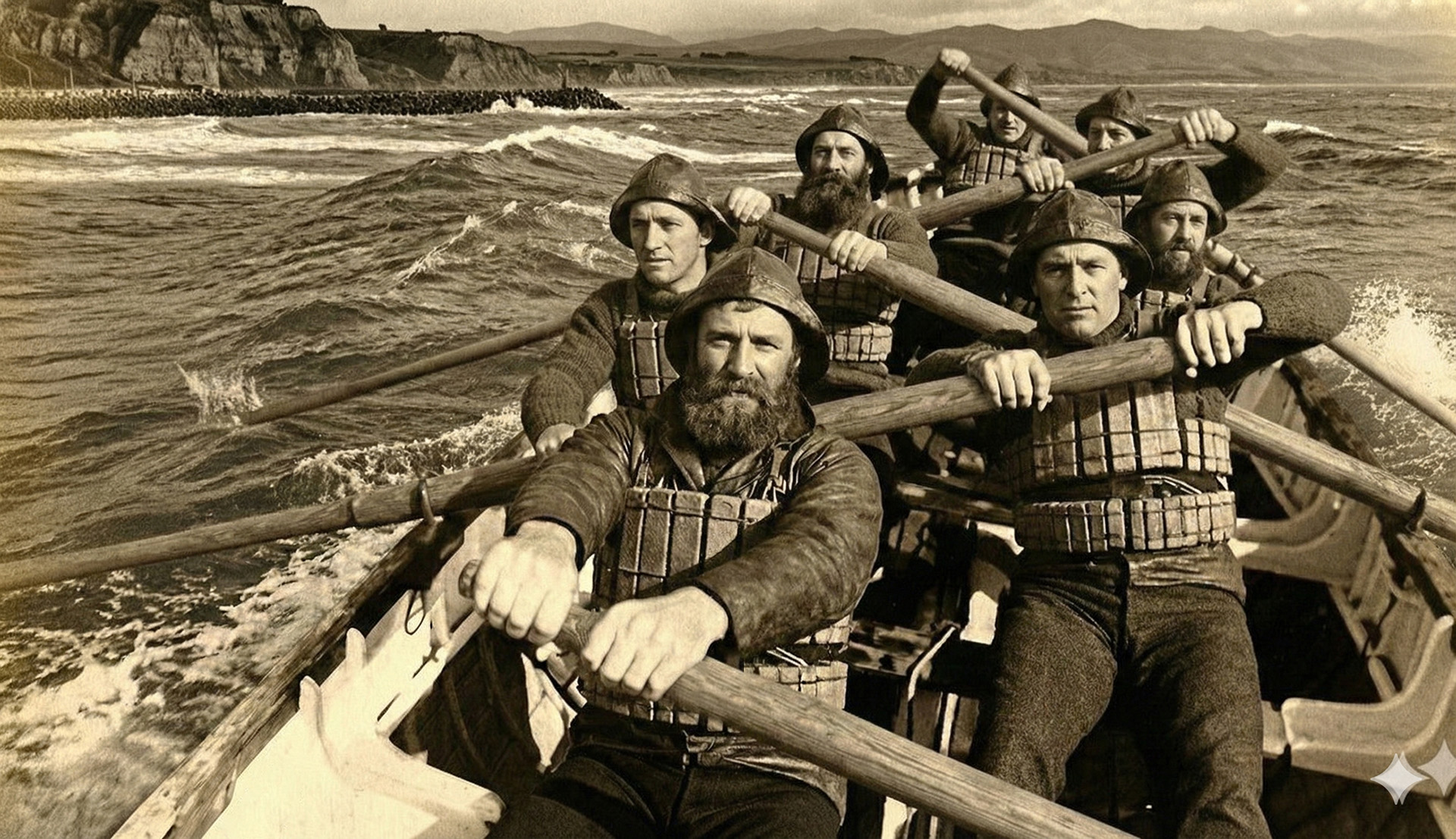
The Lifeboat Crews
This AI-generated recreation depicts a typical Alexandra lifeboat crew training for Timaru's dangerous surf.
The men who volunteered for Timaru's lifeboat service were drawn from the port's maritime community – harbor workers, sailors, pilots, and boatmen who knew the treacherous roadstead intimately. They were experienced watermen who understood the risks of the reef, the currents, and the massive rollers that swept in from the Pacific.
Each crew member wore a cork life jacket, the checkered pattern visible in this image being characteristic of these early flotation devices. When the distress gun fired, these volunteers would leave their work and families, launching into conditions that had already claimed the vessel they were attempting to rescue. It was dangerous, unpaid work driven by a sense of duty to fellow mariners in peril.
The Alexandra's crew demonstrated remarkable courage and skill throughout her service years, facing down some of the worst maritime conditions on the New Zealand coast – including the tragic events of Black Sunday, 10 September 1882, when four crew members gave their lives attempting to save others.
Behind every rescue were real people. Professional boatmen from England. Young volunteers from the artillery and rowing club. Townspeople who hauled lifeboats through streets. Ordinary citizens who became extraordinary heroes. These are their stories.
The Professional Deal Boatmen (1858-1870s)
Imported Expertise from England
In 1858, when regular landing service was established, professional life boatmen were imported from Deal, England—a town famous for its skilled maritime rescue crews. These men brought generations of seafaring expertise to Timaru's dangerous roadstead.
Strongwork Morrison
Coxswain • Landing Service employee • Stepped in for injured Captain Mills during the Susan Jane rescue (May 1869), firing a well-aimed line between fore and main masts that saved all 9 crew members.
J. Wilds
Boatman • Imported from Deal • Served in the professional landing service crew working whaleboats and surf boats for passenger and cargo transfer.
M. Corey (Morris Clayson Cory)
Boatman • Imported from Deal • Tragically drowned in October 1860 during the Wellington schooner incident—one of the first recorded deaths of professional maritime rescuers at Timaru.
Roberts
Boatman • Imported from Deal • Professional crew member in the landing service established by H.J. Le Cren.
Bowles
Boatman • Severely injured during the Wellington incident (October 1860) but survived to continue service.
P. Foster
Boatman • Imported from Deal • Member of the professional landing service crew.
Henry Clayson
Boatman • Drowned soon after arrival
Imported from Deal to work the landing service, Clayson tragically drowned soon after his arrival in Timaru, highlighting the extreme dangers these professional boatmen faced.
The Lifeboat Crews (1863-1885)
Professional and Volunteer Service
The Alexandra lifeboat operated with both paid professional crews (1863-1877) and volunteer crews (1869-1885). After Duncan Cameron's death in 1869, there was increased emphasis on professional training regardless of payment status.
Captain Alexander Mills
Harbour Master who commanded both lifeboat and Rocket Brigade. Led numerous rescues including Aurora (1870), Princess Alice incidents, and ultimately gave his life on Black Sunday (1882).
Newton
Served as second coxswain during the professional crew reorganization period (1870). Part of the formal lifeboat crew structure established after Duncan Cameron's death.
Clarkson
Professional crew member serving in the critical bow position during the reorganized lifeboat service period.
Duncan Cameron
Volunteer Lifeboat Crew Member • Died May 24-26, 1869
Former coxswain of the Taranaki surfboat service for ten years. Drowned during an unauthorized lifeboat launch to rescue the schooner Twilight. The lifeboat was undermanned and capsized repeatedly in heavy surf. His death was due to the unauthorized nature of the mission—not boat failure. This tragedy galvanized calls for a paid lifeboat crew and professional protocols.
Harry McDonald
Volunteer Rescuer • Died May 14, 1882
Lost his life during the Black Sunday rescue attempts in mountainous seas.
George Falghar
Volunteer Rescuer • Died May 14, 1882
Lost his life during the Black Sunday rescue attempts in mountainous seas.
The Rocket Brigade Volunteers (1867-1892)
Formal Organization (1877)
Following withdrawal of government subsidy for the lifeboat crew, Captain Alexander Mills organized the Rocket Brigade as a volunteer body in 1877. Membership came largely from:
- C Battery of Artillery, Timaru - Young men with discipline and teamwork training
- Timaru Rowing Club - Athletes with strength and coordination
- Local Boatmen - Experienced watermen who understood the sea
Arthur Lagden Haylock
Arrived in Timaru May 1877 at age 17 to work in Department of Lands and Survey. Witnessed Isabella Ridley wreck his first day. Became full Rocket Brigade member, responding to his first callout (Akbar, June 1879). Served through Black Sunday (1882), rowing into darkness with Carl Vogeler to rescue three men in an iron surfboat. Designed the commemorative medal for Black Sunday rescuers—a lifeboat at sea beneath the all-seeing eye. Attended the 50th anniversary as last surviving Rocket Brigade member. His daughter Greta attended the 75th.
Carl Vogeler
Rowed with Arthur Haylock into the dark on Black Sunday night to rescue three men stranded in an iron surfboat, standing waist-deep in cold water. Brought them back alive.
George Shirtcliffe
Climbed aboard the grounded brigantine Lapwing early one morning with Arthur Haylock. The tide unexpectedly lifted the ship and they found themselves adrift, questioned by workers as accidental stowaways before rowing safely ashore.
Rocket Brigade Organization
- Supreme Control: Captain Alexander Mills (Harbour Master)
- Officer Election: Members could elect their own officers
- Uniforms (1878): Blue guernseys with "TVRB" in red letters, suitable cap
- Uniforms (1883): New serge uniforms provided
- Signal: harbour gun fired to summon members during emergencies
- Duties: Voluntary watch from lighthouse crow's nest during storms
- Training: Regular practices and public demonstrations
Other Notable Rescuers
P.C. Bertram
Customs Officer • Heroic swimmer • During the Prince Consort wreck (December 1866), swam out through dangerous surf to rescue a third seaman after the Alexandra lifeboat had saved two others. His bravery complemented the professional rescue efforts.
Captain John Patterson
Master of Susan Jane • During the May 1869 grounding, made the heroic decision to cut anchors and beach his vessel deliberately. Then leapt into the surf to save a fallen crewman during rocket-buoy rescue. All 9 crew survived.
George Davis
Volunteer • Performed heroic acts during the Melrose disaster (September 1878), manually rescuing crew via ropes when rocket lines failed.
Judge Ward
Community Leader • Participated in heroic rescue efforts during the Melrose disaster (September 1878) despite his position, showing that maritime emergencies called everyone to action.
Captain Ticehurst
Surveyor • In March 1892, pulled the rocket apparatus out of storage for the Elginshire grounding near Normanby. Used it to send lines and operated the breeches buoy—the final recorded use of Timaru's rocket rescue equipment.
William Collis
Coxswain • Led whaleboat operations during Black Sunday (1882). His crews made multiple attempts to reach stranded vessels in catastrophic seas.
The Townspeople
Community Participation in Rescues
Professional crews and trained volunteers were essential, but ordinary townspeople played crucial roles in many rescues:
40-50 Townspeople
When the schooner Prince Consort wrecked, 40-50 townspeople hauled the Alexandra lifeboat to a distant launch site because foreshore conditions were poor. This community effort enabled the professional crew to reach the wreck and save lives.
Crowd of 40-50
Upon news of a vessel in distress near Arowhenua River, 40-50 people rushed to the lifeboat shed and smashed down the door with axes and crowbars, attempting to launch the Alexandra themselves. Captain Mills intervened, explaining that untrained launch would endanger rescuers. This incident proved the lifeboat was NOT abandoned—the community knew exactly where it was and cared deeply about maritime rescue.
~2,000 Witnesses
Approximately 2,000 townspeople gathered to witness the Rocket Brigade's textbook rescue of the Isabella Ridley crew. The community's presence demonstrated public support for rescue services and created witnesses to validate the Brigade's effectiveness.
Other Community Contributions
- Signal watchers - Spotting vessels in distress and raising alarms
- Bonfire lighters - Creating visibility for night rescues (Princess Alice 1875)
- Pitch fire tenders - Maintaining barrel fires on cliffs for illumination
- Human chains - Forming lines in surf to assist rescues (Wanderer 1873)
- Shore support - Providing hot food, blankets, shelter for survivors
- Equipment haulers - Moving heavy rocket apparatus over difficult terrain
- Fundraisers - Supporting rescue services financially
The Invisible Contributors
Those Who Made It Possible
Behind the dramatic rescues were people whose contributions were less visible but equally important:
Equipment Maintainers
- Cleaned and oiled rocket apparatus
- Inspected and repaired lifeboat
- Maintained ropes and lines
- Stored equipment properly
- Tested mechanisms regularly
Support Staff
- Landing service workers
- Lighthouse assistants
- Signal gun operators
- Equipment cart drivers
- Record keepers
Government Officials
- Provincial Council members who funded services
- Harbour Board members who organized rescue systems
- Surveyors who improved harbour infrastructure
- Administrators who maintained records
Family Members
- Wives who supported rescue volunteers
- Children who waited anxiously
- Mothers who raised sons to serve
- Families who bore the cost of lost loved ones
A Community Effort
Maritime rescue wasn't just about equipment—it was about people. Professional boatmen from Deal, England. Young volunteers from the artillery and rowing club. Townspeople who hauled lifeboats and lit bonfires. Ordinary citizens who became extraordinary heroes.
Together, they saved 150+ lives between 1858 and 1892.
Some gave their lives. All gave their courage.
This was Timaru's rescue community.